
Resources & Links:
- Focused Strategy Sessions with Kate
- The Divorce Survival Guide Resource Bundle
- Phoenix Rising: A Divorce Empowerment Collective
- Kate on Instagram
- Kate on Facebook
- Kate’s Substack Newsletter: Divorce Coaching Dispatch
- The Divorce Survival Guide Podcast Episodes are also available YouTube!
- Seven Step Mindset Reset for Divorce
- Dr. Cocchiola’s website
- Dr. C on Instagram
- Dr. C on Facebook
About This Episode
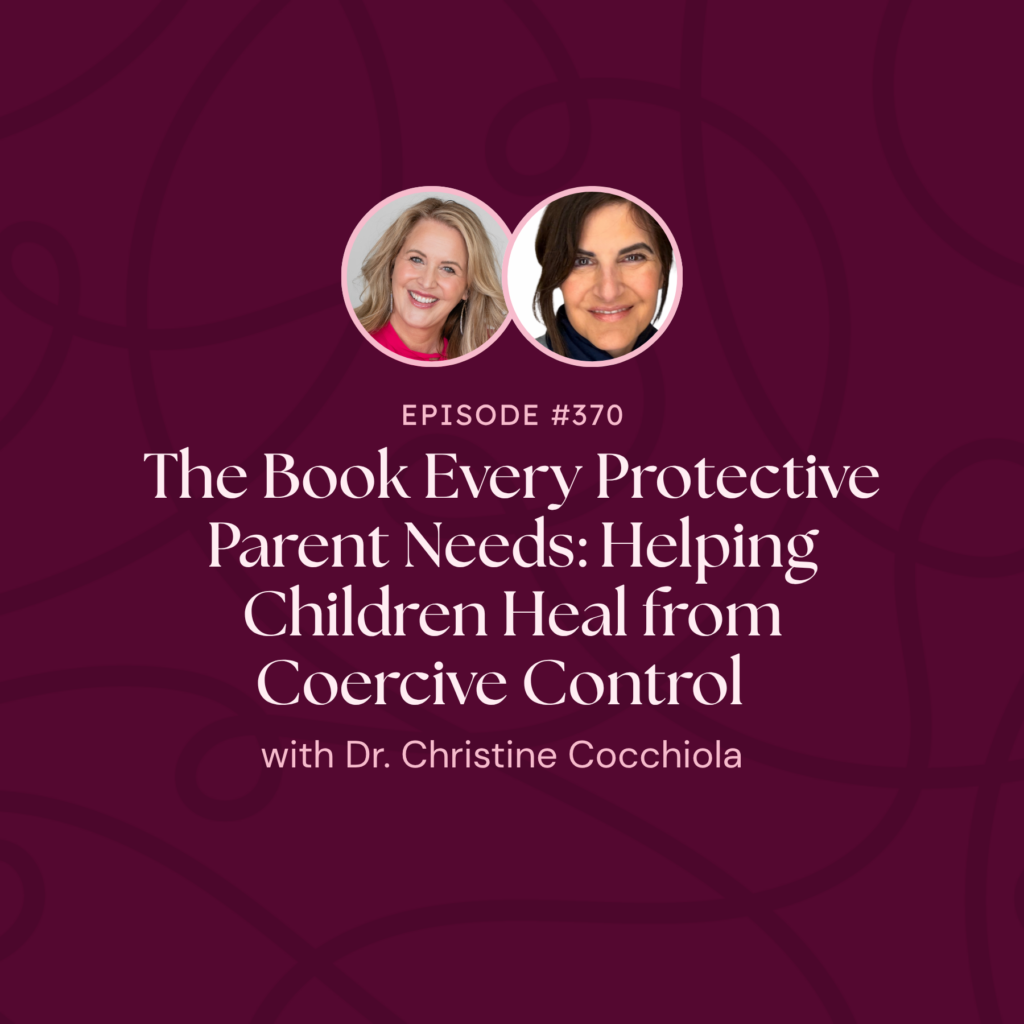
Dr. Christine Cocchiola is back with a brand-new children’s book called Every Moment of Every Day. It’s a book for kids who are going back and forth between homes when one of those homes isn’t safe. It gives children language for what they’re feeling, and it gives protective parents a roadmap for how to support them when they come home.
This book does something I haven’t seen in any other children’s book about divorce: it integrates somatic healing methods to help kids move out of survival mode and back into connection. It also gives children something abusers never do: choice and agency.
We also talk about how to co-regulate when your child comes home dysregulated, which is so hard to do, but so incredibly important. And I ask Dr. C for her thoughts on the way narcissists and coercive controllers are often conflated. She explains why they are not the same.
This is the kind of conversation that reminds me why we can’t stop being fierce advocates for the people we work with every day. As Dr. C says, when kids finally connect the dots and the attachment gets rebuilt, it’s the most beautiful thing to watch. And it starts with you.
Learn more about Dr. Christine Cocchiola:
Christine M. Cocchiola, DSW, LCSW, is a recognized expert on coercive control and its impact on adult and child victims. As a college professor of social work, she earned her Doctorate in Clinical Social Work from New York University, where she was mentored by Dr. Evan Stark, a leading authority on coercive control.
Dr. Cocchiola presents internationally on the dynamics of coercive control, educating professionals, advocates, and protective parents about children’s lived experiences and the most effective intervention strategies for victims of abuse. A social justice advocate since age 19, she developed The Protective Parenting Program, an evidence-based, attachment-focused therapeutic model designed for parents whose children have been harmed by abusive partners.
As both a survivor and protective parent, Dr. Cocchiola brings personal insight to her professional work. She is the author of the children’s book Every Moment of Every Day and co-author of FRAMED: Women in the Family Court Underworld. Her TEDx talk with over 1.4 M views, “It is ALL Coercive Control,” is available on YouTube.
What you’ll hear about in this episode:
- Why Dr. C wrote a children’s book specifically for kids in shared custody situations with an abusive parent, and what she was trying to give them (4:59)
- How the book helps kids identify what they’re feeling in their body, not just their emotions (6:43)
- What makes this book different from other divorce books, which tend to normalize and soften when kids actually need to be seen (9:53)
- How the book integrates somatic healing methods, and what that looks like in practice (10:42)
- Why narcissists and coercive controllers are not the same, and why that distinction matters enormously for how you navigate these systems (21:48)
- What Dr. C has learned from her own experience of parental alienation, and the beautiful reunification stories she’s seeing now (34:12)
- Why telling your kids “Dad loves you and is doing the best he can” may actually be gaslighting them (37:33)
Disclaimer
The commentary and opinions available on this podcast are for informational and entertainment purposes only and not for the purpose of providing legal or psychological advice. You should contact an attorney, coach, or therapist in your state to obtain advice with respect to any particular issue or problem.
View Full Podcast Episode Transcript
Kate Anthony: [00:00:00] Hey everyone, welcome back. I am thrilled to bring you my, one of my favorite guests, my dear friend, Dr. Christine Cocchiola. She’s an expert on the experiences of adult and child victims living in a home with an abuser. She has been a social justice advocate since the age of 19, volunteering for a local domestic violence sexual assault agency.
She’s a college professor teaching social work for over 20 years. She received her doctorate in critical social work from NYU. She is the creator of the Protective Parenting Program, which is a clinical intervention program for protective parents based in attachment theory. Highly, highly recommend. If you are, if you identify as a protective parent and have not taken Christine’s class her, done her Protective Parenting Program it will honestly change a lot of things for you.
So please check it [00:01:00] out. She- you have live versions, right? You have self-study versions. You’ve got all of the versions for all of the price points and the availabilities and all of that stuff, right? Yes. And Christine is the author of now two books. One, her brand-new book is out now for children, and it’s called Every Moment of Every Day, and I am going to let you, Christine, talk a little bit about the book.
Who is this book for, and why is it so important?
Dr. Christine Cocchiola: Thank you so much for being here. You were one– I think this podcast was one of my first ever podcasts. Yeah. Back in the day. Wow. Yes.
Kate Anthony: Back in the day.
Dr. Christine Cocchiola: Yeah, when we were first talking about what is coercive control- What is coercive- Right? And for your listeners, I, when I went for my doctorate, I worked under Dr.
Evan Stark, who’s the advancer of the term coercive control. He was on my [00:02:00] committee. I was so fortunate to get to have that amazing man as my tutor, the godfather, of course, of control, as we say. But yeah, no, I just I, as I wrote the book, co-authored the book Framed: Women in the Family Court Underworld, and you and I have had this conversation so many times where why do we talk about women as victims?
We know that men suffer abuse. We know that. No one’s denying that. But we live in a world where the amount of women and children Who are in so many ways more vulnerable and harmed. It’s almost I talk about this in my TEDx, it’s like we talk about breast cancer, no one gets offended that women suffer it at a greater rate, right?
Kate Anthony: Men get it. Yeah. But yeah, exactly.
Dr. Christine Cocchiola: But men will go out and walk in a pink shirt and in a pink tutu for breast cancer, right? And we’ll say- Exactly. … It’s not offensive. That’s right. But the moment we start talking about domestic abuse and control dynamics, controlling dynamics in relationships, there’s a [00:03:00] there’s a little bit of a defense that comes up what about the fathers?
What about the men?” My work is primarily, it’s with protective parents as you referenced. I do have dads. Many of the dads I work with are gay. They’re in oppressive relationships with other men. Yeah. And so I wrote this book for protective mothers and the same situation with Framed when we talked about women in the family court underworld.
If we don’t recognize that the systems are based on patriarchy- That there is inequality. Yeah. Oh, what’s it say? My,
Kate Anthony: my fuck the patriarchy necklace. Yes.
Dr. Christine Cocchiola: I love it. I
Kate Anthony: love
Dr. Christine Cocchiola: it. There’s systemic coercive control. We’re seeing this on the grander stage right now with the Epstein files. It’s systemic coercive control.
Kate Anthony: Yep.
Dr. Christine Cocchiola: And we’re silenced, and in general, women are silenced at greater rates. So anyway, I decided to write a book for protected mothers, and the book is really a book for children who [00:04:00] are– It could be for anybody divorcing, by the way. Anybody at all. But if a kiddo is afraid to go to their– They don’t wanna go, “Mommy, I don’t wanna go,” or when they’re coming home, they’re dysregulated.
It really gives children the language of how what they’re experiencing is okay, it’s normal, and that when they come home, whether they’re– I say, “And sometimes when it’s time to go, I maybe cry and get angry, but really I’m just sad.” This little girl is just sad, right? Yeah. And he says, “My body feels uncomfortable, my belly or my head, or maybe it’s another part of me, something feels bad.”
So we help them to understand what they’re feeling in their body, and then how a protective parent can meet them where they are. What is it that I need to do differently so that when my child comes home dysregulated or when they don’t wanna go, how can I truly be attuned to them? Help them tru- there’s a way to help kids heal when they’re feeling really dysregulated.
[00:05:00] So I wanted to get something like a little handbook, a little book out for protective parents and mothers in particular. It’s so great,
Kate Anthony: and I love that it’s helping kids identify their feelings, right? ‘Cause I love the– just even that passage that you read just now, it’s yeah I do get home and I fe- and I’m angry and I throw a tantrum.
But yeah I… and because kids don’t know what is happening to them. God love him. I remember my son when he was going through puberty, like this has nothing to do with our divorce or anything like that, but he was going through puberty. He was like 11 years old, and he was just surging with all these hormones, and he just screamed one day, “Mommy, mommy, I’m so angry all the time.
I don’t know what’s happening to me.” And I was just like, “Oh. Oh, beautiful,” right? This is what’s happening to you, right? They have all these feelings, but they just don’t, they don’t know why. They don’t know what’s happening to them. And it’s our job to name it, right? And so when– and the sort of [00:06:00] differentiation of a book is sometimes so much easier for them to connect to, right?
Dr. Christine Cocchiola: Yeah. Yeah. Children will show us how they feel before they tell us how they feel, right? And so if you imagine that your child has to go to the other person’s house, maybe family court has required it, even if there’s been experiences of harm, that’s a really challenging thing for a protective parent to navigate.
I act- it’s a moral injury. We talk about that, right? It’s a, I actually have to make you go somewhere where I really don’t think you’re safe. And by the way, I can’t tell you that I don’t want you to go, because if I tell you I don’t want you to go and that gets reported back to the court, I’m gonna be in trouble.
So how do I help you to understand that- You’re gonna go, and this is part of what we do every Saturday or whatever. But also, I’m right here waiting for you. Every moment of every day, I am just right here waiting for you. And when you come back, you can come back any [00:07:00] way you want.
It doesn’t matter.
When you come back, I will let you… And so part of the story is, I’ll just I’ll sit quietly with you if you want. We can read a story. We can make a pillow tent and hide. We can dance. Because some of the things that I try to share in the book are they’re somatic healing experiences.
Yeah. Movement helps. Repeti- things have to be relational, repetitive, often rhythmic helps.
These are all ways to heal a dysregulated brain. Ask yourself when we, when you and I are feeling stressed and we turn on our favorite music, we might cry, ’cause it makes us cry, or we might dance. It actually helps our bodies to heal.
Kate Anthony: Yeah.
Dr. Christine Cocchiola: And so how can a protective parent actually start doing these things with their child when they’re feeling dysregulated?
Kate Anthony: Yeah. Ugh. Yeah. I love it so much. I love that part of it so much. And we, there are other [00:08:00] books out there for divorce, right? And this is obviously different because we’re dealing with not just I think the other books about divorce often are, like, normalizing, and everything’s fine, and you’re gonna have two homes, and everything’s gonna be great.
And this book is more like, “Yeah, it kinda sucks.” Like- and it’s hard, right? What are some other differences that you see specifically with this book? And what are the age what’s the age bracket that you feel like this is good for?
Dr. Christine Cocchiola: I would say 2 or so to 10 or 12. I have a mom who, she reads the same book to her 12-year-old.
She’s reading it every night to help her 12-year-old regulate before he has to go off to his other parent’s home. I think a major difference is that it actually integrates somatic healing, which is a therapy that we use with people who are feeling dysregulated. So Dr. Bruce Perry, his work is quite remarkable, and he I use his work when I teach about attachment theory and when I do my protective parenting program, and he talks about the [00:09:00] neurosequential model of the brain.
And-
Kate Anthony: Yeah.
Dr. Christine Cocchiola: So the lower part of the brain is, I’m dysregulated, I’m in survival mode, right? Like way down here. Bessel van der Kroft talks about it. He says it’s the cockroach part of the brain, right? And so what I do with the book is integrate how do we get a child out of survival mode so that they’re more able to attach to you Because when they attach, they feel safe.
Yes. And so it’s all comes back to attachment theory and somatic healing being integrated together. So the tools that protective parents are getting from this very simple book is exactly how to do that in those moments.
Kate Anthony: So brilliant So absolutely brilliant. As, everything you do is brilliant.
Can you share some of the stra- the somatic strategies? I know that you’ve shared a
Dr. Christine Cocchiola: lot of yours- Yes,
Kate Anthony: I’ve shared a few of them, but I’m curious about some others.
Dr. Christine Cocchiola: The mom says, “When you come back home, I’ll be waiting [00:11:00] here. Mom can give you space or your favorite games we can play.” So it’s about choice and agency now.
Really what we’re talking about is giving a child an opportunity to choose what they want to do versus us telling them what to do. Now, what do abusers do in these family systems? They’re
Kate Anthony: authoritarian, and they don’t give us any choice whatsoever. Yes.
Dr. Christine Cocchiola: No. And and so you can take a bath or we can go for a walk.
Mom can listen to you sharing how you feel seems okay. So we give them permission to talk to us, but we also give them permission to be quiet. And that when they come to us, we really, we aren’t going to force any of it, right? And so it’s really, I, we call it co-regulation in the therapeutic world.
How do I co-regulate with my kid? I attune with where they are. Is now the time to discipline them or make them eat their peas?
Kate Anthony: Okay.
Dr. Christine Cocchiola: No. [00:12:00] Maybe not. Maybe now, then maybe they’ll have more vegetables tomorrow, but today I’m not gonna get into that battle because they’re dysregulated, they’re overwhelmed.
And it means that protective parents have to let go a little bit. This is hard. It’s hard. We wanna ask them, “How was your visit? Did you see dad and his girlfriend? Was grandma there? What are the things dad told you about me?” There tends to be, right? He’s “Don’t do that. Don’t do that.”
“Don’t do that. Don’t do that.” So healthy attachment comes from the ability for a child to just be themselves with us.
Kate Anthony: Yes.
Dr. Christine Cocchiola: And this abuser doesn’t allow them to be them- themselves with us. And so now when your child’s coming home and you’re asking these, questions you’re grilling them a little bit or you’re curious and they know you’re curious, or you want them to eat their dinner or you don’t want them, to go outside and run around right now, and they might need to run around right now.
They might need to [00:13:00] have quiet right now. They might need to… I have one little guy, he every time he comes home from dad’s house, he’s 12, every time he comes home, the rule in the family system, they created it, so this is like, how do we create guidelines for our kids that we’re willing to be flexible on?
They came– The mom and the son came up with this little, this is gonna be the pattern that they’re gonna do. Every time he comes home, he walks in the door, he doesn’t even say hello to his mother. Doesn’t even say hello. He goes directly upstairs to take a shower. Yes.
Kate Anthony: Which is ner- regulating his nervous system right then and there.
That’s amazing. That’s wonderful.
Dr. Christine Cocchiola: And they always have tacos?
Kate Anthony: Yes.
Dr. Christine Cocchiola: It’s like, it, he knows
Kate Anthony: what to expect.
Dr. Christine Cocchiola: He knows what to expect
Kate Anthony: exactly. It’s if he goes from a completely unpredictable environment or predictable with harm to something that is predictable and safe.
Dr. Christine Cocchiola: 100%. A- and then she’s not allowed to ask about his visit, and he will talk about it if he wants to. But he’s– they just get to do the things [00:14:00] that they want to do.
Yes. Yeah. They get to… And so that is about, And a lot of people will say, “But you’re letting– Like, isn’t that permissive parenting? They don’t have any rules. They…” I’m like no, there’s a difference between having rules and having some structure and giving a child carte blanche.”
We’re not giving them carte blanche, but we’re-
Kate Anthony: We’re
Dr. Christine Cocchiola: giving them
Kate Anthony: agency …
Dr. Christine Cocchiola: we’re c-
Kate Anthony: we’re also, like- Yes … allowing them to identify their needs, right? I think one of the more important pieces of this too is that when you’re in a relationship with an abuser, you are systematically deprived of your ability to know how you feel, think, what you need, because we’re always gaslit about your feelings are wrong, what you need is wrong, you’re…
right? And so we learn to diminish all those things, and then we lose trust in ourselves, in our ability to trust ourselves, right? And so the way that we build self-trust is by ch- [00:15:00] just those little micro check-ins. What do I need? I need a shower. I need to not talk to anybody. And then you honor that, and you start to rebuild trust in yourself.
Yes, it’s permissive. It is permissive. It’s giving your children permission to honor- … the very- … core needs that they have- And- … and their body and what they know that they need in this moment.
Dr. Christine Cocchiola: 100%. It’s so important, right? That they actually understand that we get them, and part of what happens, right?
Is that when we are correcting them, when we are saying, “No, you can’t do that now, you have to…” Y-we– it doesn’t feel like connection to them. And remember, if you’re, if you are coming from an abuser’s house, the goal of the abuser is to have the child actually not follow your rules. Is to have the child go against you.
So when you’re, like, upset about them not following the rules- Yeah, … guess who won? The abuser. These predatory parents, [00:16:00] they prey upon the children, and they love to use the children as the weapon to upset everything.
So every time you get upset, remember who you’re really satisfying.
Yep. Is the abuser. Like- Yep … it’s alm- it’s like if you have a battle that you’re not gonna win anyway, then why have a battle?
Kate Anthony: Totally. Totally. I remember when my son I don’t remember how old he was quite young though, and he said, “Mommy,” on Wednesdays, ’cause we were on a 2-2-5-5 at that time, and he said, “Mommy, on Wednesdays when I come back to your house, I don’t want play dates.”
I just wanna be home with you. And I was like, “Oh my God.” First of all, the idea that he… he was like six or seven, and that he was like, “No play dates. This is, I just need to like…” Basically, he was saying, “I need to ground myself in our home and [00:18:00] in my attachment to you,” is what he was saying.
Yeah. In not so many words. My immediate response was a- abso-fucking-lutely. Abso- absolutely. Of course. Yeah. Because my kid is telling me what he needs really clearly.
Dr. Christine Cocchiola: And so the next step to that is could you imagine if we could actually take some time to think about what our child might need- versus them- Having to say it, that, like almost offering options to them. Yeah. Almost… instead of us living in a state of hypervigilance, they’re coming home soon, what am I gonna do? I have to have x… a- stop for a moment. Just stop and ask yourself, what do, what is really, what is it really that your child’s gonna need when they come home?
You know your kid better than anybody. This is what, we have these conversations. The appeals for these, whether it’s a divorce and there’s a less engaged parent, and they’re, they may have 50/50 just because. Yeah. They don’t know your child the way that you know your child.
That’s right. And do we take the time to intentionally think about what the needs [00:19:00] are of that child? I don’t know if we really do, especially if you’re reeling from an abusive relationship. It’s really hard. We all are. And I’m saying, you know what? Take the time to do it, because if you could fortify this attachment with your child, it’s sometimes, as two steps back, one step forward, or two, like two steps forward, one step back.
Absolutely. It’s really challenging, but if you could fortify your attachment with your child, you’re
Kate Anthony: gonna heal. Yeah.
Dr. Christine Cocchiola: You’re gonna heal.
Kate Anthony: I love that.
There was something that we were talking about before. I wanna switch gears a little bit, unless there’s anything else you wanna say. The book is about… we’ll come back to the book obviously, I think throughout this conversation. But there’s something that we were talking about before we hit record, and we were talking about the difference that…
I was saying to Christine that when we first met, the term coercive control was just not in our, everyday lexicon. We were not talking about it the [00:22:00] way that we are now, and I was acknowledging that I feel like you had a tremendous amount to do with that. And I was just saying that I was super proud that she had changed our culture in that way.
You told me that you were- you’re actually gonna be doing a training with Dr. Ramani because now we’re re- now you guys are realizing that narcissists and coercive controllers are being conflated and that they’re not the same. So say more, please.
Dr. Christine Cocchiola: Sure. And it’s always helpful, I think it’s always helpful to also put out there the definition of coercive control.
Yeah. Because I think we, we just wanna make sure everybody has clarity. Yeah. It- a lot of people think it’s hidden abuse or it’s not physically violent, therefore you suffered coercive control and physical violence. And what people have to understand, it’s all coercive control. Abusers don’t typically show up hitting us.
They use tactics, psychological tactics that sometimes feel really good, by the [00:23:00] way. L- love bombing, future faking, all of these parts, this person where they’re soulmate, et cetera. They use all these good things, but then they also use gaslighting and manipulation and intimidation and isolation.
Unfortunately, when we attempt to escape, they often, they engage in post-separation abuse, which is the intensifying of coercion and control. And what we see is that whether someone suffered physical or other violence in their life, and somebody call- some people call psychological abuse psychological violence, of course it is.
But if we were to just talk about physicality- Yeah … whether it’s physical or sexual, unfortunately people think if I suffered that, then it wasn’t coercive control.” And I want everyone listening to know that it’s all coercive control. Yeah. It just so happens some abusers are pretty damn savvy and also have better coping mechanisms.
They don’t show their anger and physicality as quickly as other abusers do. [00:20:00] They hold it in. They’re gonna show it in other ways. That doesn’t mean they won’t ever physically abuse you. So it’s a trajectory of behavior. Some abusers get to physical violence or sexual violence, some don’t, and that’s the reality, right?
So and then we hood- we hoodwink ourselves ’cause then we’re like, “Oh, I didn’t suffer real abuse,” and it’s all abuse.
Kate Anthony: That’s right.
Dr. Christine Cocchiola: It’s psychological warfare. Absolutely. And
Kate Anthony: You and I have heard a million times from women whose h- whose abusers have physically harmed them, that the emotional and psychological torture was actually worse As horrible as that sounds, and I don’t think we need to compare and put things on a scale.
But for context, I think it’s important to understand that women who have been physically abused and assaulted, many of them will say that wasn’t the worst of it.
Dr. Christine Cocchiola: Yeah. As a matter of fact, those are exact words I use in my TEDx. I say that psycho– that feminist psychologists would say [00:25:00] that the worst part was the fear of what comes next.
Kate Anthony: That’s right. Yes.
Dr. Christine Cocchiola: And so in no way are, like you said, are we diminishing, the physical violence. But what we do know is that when abuse is something that you can’t visibly see, it is– what research is showing us, it is more traumatic because it’s hard to describe. Yes. Because you don’t even know what’s happening, because other people don’t acknowledge it.
If you had just been hit, if you had just been hit, then it would be very easy to describe to everybody. You’d have a bruise. This is the interesting part about this training that we’re trying hard to educate people on. A lot of people use the word, as narcissism pretty– we’re using it a lot, right?
Kate Anthony: Yeah.
Dr. Christine Cocchiola: The people that are coercive controllers, if we were to like– and we don’t have research that actually connects this, but we do have dark tetrad research that came out in February twenty twenty-four. And that’s– it’s four aspects: narcissism- Which we all know is grandiosity, self-serving. A lot of [00:27:00] people mistake the fact– They say that narcissists don’t have empathy.
That’s not true. They have something called cognitive empathy. They can intellectualize empathy. But they can’t, they don’t have affective, that’s A-F-F, affective empathy. They’re not able to really put themselves in someone else’s shoes, but they could certainly make it seem- They can mimic it.
Kate Anthony: Yes. Yeah.
Dr. Christine Cocchiola: There we go.
Kate Anthony: Yeah.
Dr. Christine Cocchiola: So narcissism. The next is Machiavellianism. So highly manipulative people where they can get other people engaged in their narrative like this, including the systems, CPS, Child Protective Services, family court, criminal, police. How many of your clients, really, Kate, how many of your clients the abuser was friends with the police?
Kate Anthony: Or was one. Or, —
Dr. Christine Cocchiola: or was one. There we go.
Kate Anthony: Law enforcement
Dr. Christine Cocchiola: is- There we
Kate Anthony: go … full of them. Yep.
Dr. Christine Cocchiola: That’s right. That’s right. So the ability to manipulate the system, to play the system, to play others, so that’s [00:28:00] the next level. Psychopathy is the third. The willingness to break the law or…
And people say to me he didn’t break the law.” I’m like did he stalk you? ‘Cause that’s breaking the law. Is he tracking your phone? That’s breaking the law. Is he recording you in a one state recording state? That’s breaking the law.” We have to really consider that these abusers have already been breaking the law.
Kate Anthony: A-and what makes it so infuriating is that the law then doesn’t consider, you don’t have enough evidence. You, there, nobody’s actually enforcing- these laws. And so therefore we think it’s not actually bad enough. By the way, it is. It may not rise to the level that of the amount of evidence and whatever that you need to prove it in a corrupt, fucked up system.
But that doesn’t not– that doesn’t make it legal or okay.
Dr. Christine Cocchiola: Yeah. And so that’s like when we think about the pain of a victim, not only are you dealing with [00:29:00] someone who can’t truly empathize with your experiences, probably using vulnerabilities against you, mocking you, self-serving, right? And when that self-serving is occurring, every single victim of abuse has suffered 99%.
Every single victim has suffered financial abuse. So self-serving, right? And then going to this manipulative where you know that people are hearing things about you, you don’t know where they’re hearing it, or you know that there’s an untruth out there, or your children are coming home, and they have a false narrative about you, and you’re wondering why they’re dysregulated and overwhelmed.
And then this whole psychopathy part where they are breaking the law. They’ve been breaking the law. They’re not following parenting agreements, breaking the law. They’re in contempt of– They’re not paying child support, breaking the law. And then the last one is sadism. These individuals, the coercive controller, not all narcissists are coercive controllers.
All coercive controllers- Are narcissists …
Kate Anthony: are
Dr. Christine Cocchiola: narcissists, [00:25:00] Machiavellian, have tendencies to break the law, and also are sadistic. They actually enjoy inflicting harm.
Kate Anthony: It is– it’s such an important distinction. I was gonna stop myself and go somewhere else, but I’m like in, I’m in two places at once. One is it’s an important distinction because the coercive controller, because of the sadism and the psychopathy, that they’re actually getting off on it.
It’s a very different way that you have to deal with them and operate inside of all of these systems with them. The narcissist, yes, that too, but they’re not actually out to harm you necessarily. The benign the more benign f- I think half of the spectrum or something, let’s say if it’s a spectrum, narcissism from more, more benign to NPD, right?
Tell me if you agree with this, Christine, ’cause you’re the expert. But it feels like the lower [00:31:00] end of that spectrum, they’re really just, they’re trying to get their needs met. They’re trying to get the bottomless pit of their needs met, and in the process, they’re hurting you, and they are annihilating you and doing all of these things, but that’s not the…
It may be the byproduct, and they may not care, but it may not be the goal. Is that what you’re saying here?
Dr. Christine Cocchiola: I think that’s a really great way to put it, and I think that if you’re dealing with a narcissist or someone who’s narcissistically abusing you, they might be, on a scale of one to 10, like a five or a six.
My clients, the people I directly work with- Yeah … are dealing with the tens. Every single person that I am working with, every single one of them, the abusive person, literally, they have- The amount of shame that they’re carrying as a result of their own experiences, as a result of how they were born, the traits that they have, the amount of shame they are carrying, the only [00:33:00] reaction to being even slightly exposed because of a divorce, not even like telling the world that you’re an abuser.
But just a divorce, that in and of itself is enough that I have to destroy you. In some way. Yes. Now, financially, psychologically with my flying monkeys- … legally, vexatious litigation, weaponizing the children, and in the worst of cases, as femicide and filicide. And so that’s why I always say it is a trajectory of behavior.
Not all abusers will use physical violence, but they’ll find every other way around it, and they’re very savvy. To your point, a lot of the lower level people are just not as savvy. They can’t, they’re this sounds really rude, but they’re kinda dumb. They show up to court and if they get instigated by somebody in court, they might behave badly, and then the court professionals are like, “Oh, we know who the jerk is here.”
The savvy ones, the more very covert and able to manipulate [00:34:00] so well the system, no one in court would ever in a million years think they’re a bad human being. Or they’re paying off those people in court, as and they have relationships. They’re a lawyer, they’re, they don’t have to be a lawyer.
They could be a plumber, but they’re paying off the court professionals so that the situation is sided with them so they could destroy the other person, because that’s, what’s the one thing that would destroy the other person?
And their children.
Kate Anthony: That’s it. You and I have both been doing this for a really long time, and I know we have both suffered periods of it’s hard to do our job.
And I think you more than you and Tina in particular, it’s really hard and unsafe often. It’s emotionally unsafe. It can be physically unsafe to do our job. How do you regulate and maintain your sense of safety and keep your head on your shoulders and not curl up in a fetal position every minute of every day?[00:35:00]
Dr. Christine Cocchiola: Oh gosh, I don’t think anybody’s ever asked me that question
Kate Anthony: Really?
Dr. Christine Cocchiola: I don’t think so. No. Maybe my therapist, but
Kate Anthony: Right. Good.
Dr. Christine Cocchiola: Yeah. No, but yeah, like in a per- like in a colleague to colleague, friend to… I don’t know. I think part of my trauma response is to keep working, which is probably problematic.
I don’t take breaks. You don’t.
Kate Anthony: I know. We’ve talked about- No … we’ve
Dr. Christine Cocchiola: talked
Kate Anthony: about your overwork as well.
Dr. Christine Cocchiola: Yeah. Yeah. And so as you… Yeah. Yeah. I love tennis when I can find, when I do try to make time for that every week. Yeah. So that’s a really good thing. And of course- Yes … my dad is very important in my life and family, but and of course, of course my kids.
Kate Anthony: Your kids, of course. But they’re busy and they’re living their best lives right now
Dr. Christine Cocchiola: It’s amazing.
Kate Anthony: Yeah.
Dr. Christine Cocchiola: It’s amazing, yeah. But for people who don’t know, and I wanna let everyone know, I wrote this book for little children, but my children were indoctrinated against me. Yes. So I get [00:36:00] what protective parents are experiencing firsthand.
And I will tell you these really beautiful stories I’m having lately. I’ve had, for some reason, you know the law of attraction? I’ve had these moms who are working with me because their kids aren’t talking to them and then their kids actually want therapy. They’re adult children, like 17, maybe 18, 20.
I have a 32-year-old, he hadn’t seen his mother for three years, and on Easter Sunday she saw her grandchildren for the first time. And, That’s, yeah … that’s why
Kate Anthony: we, that’s why we can’t stop.
Dr. Christine Cocchiola: That’s totally why we can’t stop. It’s the most beautiful thing to watch this sh- this young man, he’s not so young, right?
Come together with his mother and realize why his mother was dysregulated, why she was, like, overwhelmed when he would come back and forth, with dad, and et cetera. Like all of a sudden h- he’s connected the dots and said, “Wait a minute, mom was not the best mom, but why wasn’t she?
Was she influenced by this pain she was [00:37:00] having?” And she’s able to apologize, and they’re being able to build trust. It’s a beautiful thing. I really do believe. I love
Kate Anthony: that. I love that. It’s so true. It is the thing that keeps us going. E- every client email, every every win for our clients is…
Tell us about them. Don’t be– if you’re, like, an old client of either one of us or whatever, my God, tell us.
Dr. Christine Cocchiola: Tell us. Please let us know.
Kate Anthony: Yeah,
Dr. Christine Cocchiola: be- It makes our day.
Kate Anthony: It does. It makes it all worthwhile. Christine- Okay … where can everyone find your book? I feel like it’s so important. And I wanna just say for your children, right?
You were alien- you were alienated from your children. You, w- they were, had turned against you. And what shifted it for them and for you?
Dr. Christine Cocchiola: I basically became, and it’s why I created the Protective Parenting program, because I realized I had to be more of a therapist in the home. I had to meet them where they were- Yeah
and really parent entirely differently. Because when you’re being abused, actively abused by the other parent, [00:38:00] and you come home, y- your trust is gone The attachment has been maliciously fractured. And so how did… I knew I had to rebuild it all the time. It was, like, constantly. It’s like a Lego. You just keep building it, and they break it.
And they like crash it. And then you build it. And it’s… I’m lucky. My, my son wasn’t as indoctrinated, but certainly thought I was cuckoo for Cocoa Puffs. And my daughter was, and they gained clarity. And part of that, by the way, Kate, is letting the kids see who the abuser really is.
Kate Anthony: Yeah, you ta- you know, you were one of the first people to say that out loud in this space.
And I remember hearing you say it for the first time, and I was like, “Oh, shit.” One of the things you said is that never, ever… I remember you saying this to me, and I was like, “Fuck.” Never, ever say, “But your dad’s doing the best he can, and he, I know he loves you.” Because we don’t want them to equate that behavior with love, because that’s how they get [00:39:00] mapped to be abused, right?
And I was like, “Oh, fuck.” So true.
Dr. Christine Cocchiola: It’s part of our training has always been never put children in the middle, never disparage the other parent. We never disparage the other parent. We just don’t have to elevate them. Stop elevating them.
Kate Anthony: And we can and we can validate their feelings.
Validating, telling our children “Oh, your dad loves you, and he’s doing the best he can,” and whitewashing the abuse is gaslighting our children.
Dr. Christine Cocchiola: You’re brilliant. Absolutely
Kate Anthony: I’m not, and I-
Dr. Christine Cocchiola: You are
Kate Anthony: brilliant. So awesome … from press probably directly from you, my friend. We can’t do that to them.
We have to name it and say “Actually, yeah, you’re right. That’s not okay. I’m so sorry your dad did that. So sorry he said that.”
Kate Anthony: “That, that must have felt how did that make you feel?” Or, “Or you must have felt really upset,” or con- “It must be really confusing” or something to validate their feelings and experiences of it.
That’s not vilifying. That’s not bad-mouthing. That’s [00:41:00] actually just naming what happened.
Dr. Christine Cocchiola: No. And you could even take out the word dad. Okay. You could even say, “I’m really, that, that shouldn’t happen to anyone,” right? Or, “I’m sorry that happened, and it really shouldn’t happen,” versus even bringing in the word dad.
Because a lot of these kiddos are triggered the moment we bring up the word dad or, and that’s the other thing, I don’t know if you’ve ever heard people say this, “Stop calling him Daddy.”
Kate Anthony: Oh,
Dr. Christine Cocchiola: Just stop.
Kate Anthony: Yes.
Dr. Christine Cocchiola: That’s too affectionate. I call him Dad. You can call him Daddy if you want, but I call him Dad.
That’s right.
Kate Anthony: Your
Dr. Christine Cocchiola: father. Your father. Separate. Create some boundaries. How do we expect our children to have clarity around these people when we’re not actually acting the part with boundaries? Yes.
Kate Anthony: Yes. And it’s-
Dr. Christine Cocchiola: Playing nice in the
Kate Anthony: sandbox … and by the way this is so hard to do when you are also dysregulated and feel, which is why you need Christine’s Protective Parenting Program because-
it teaches you how to do that in a way that incorporates the fact that you are also dysregulated. It’s [00:42:00] real easy for us to sit here and talk about it.
Dr. Christine Cocchiola: Yeah.
Kate Anthony: Doing it is something else.
Dr. Christine Cocchiola: I would say, I offer all kinds, as I know you do, all kinds of information on Instagram and Facebook, et cetera, because I know that people are struggling, and it’s important for people to get affirmation.
They’re not crazy. You don’t have to do this alone. There’s a world of support. That’s right. And we all deserve that support, especially after experiencing this. Yep. But most importantly, the kids deserve support from you.
Kate Anthony: So speaking of Instagram and Facebook and everything, where can everybody find you and buy your book and all the things, if they’re not already following you, which
Dr. Christine Cocchiola: I, that would be crazy.
The books are on all major book sellers, so Amazon, Barnes & Noble, and also you can find me on Instagram under Coercive Control. I think as soon as you put in Dr. Cochiola or Dr. C, Coercive Control, you’ll find me, and I’m happy to support anybody. And we have a team of clinicians who are trained by me who provide one-on-one support [00:43:00] also.
Kate Anthony: So good …
Dr. Christine Cocchiola: Anything that we can do.
Kate Anthony: Oh, you’re the best. Yeah. You are the absolute best. I love and adore you. Thank you for being here, and congratulations on the book. I think I, as you were reading it, I was thinking- Do you have a companion piece for moms to explain what each of these things, like all the co-regulation, how each thing, like why this on this page, this is what you’re doing?
Dr. Christine Cocchiola: That’s a really great idea. I don’t– I have an explanation in the back of the book about what somatic healing is. And now that I think I also probably need to create one for dads. Yeah. Like it’d be nice to have a book like this that dads who are protective parents when their kids don’t wanna go, and they can support them in that way too.
Yep. So lots of ideas. I think I need to be about 20 years younger. I know you do not. That’s a great way to make
Kate Anthony: it. You just need– I just need to have a few more brains and hands and everything. Yeah, exactly.
Dr. Christine Cocchiola:There we go. There we go. Thank you so much. I appreciate it.
Kate Anthony: I love and adore you. Thank you so much for being here.
Dr. Christine Cocchiola: Love you too.