
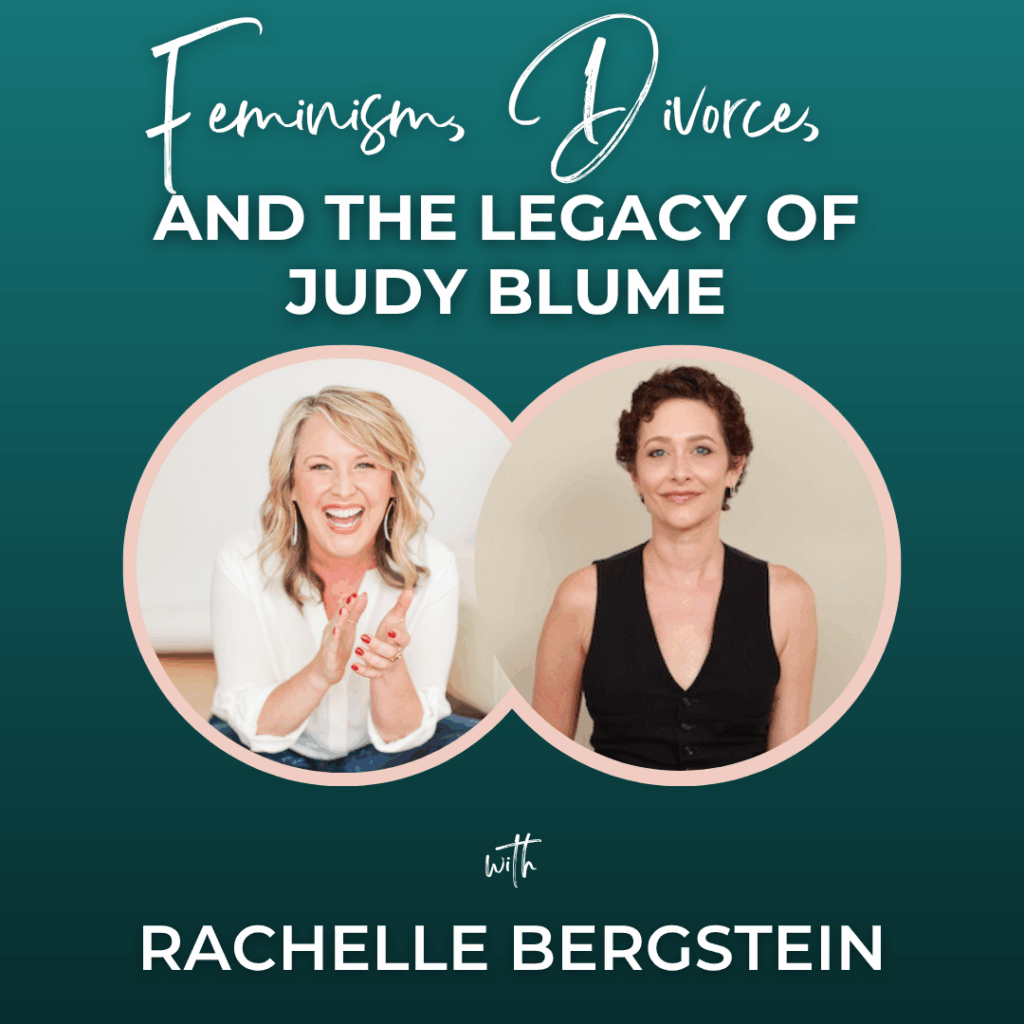
Judy Blume and feminism? Yes, please. Add in divorce… and we got ourselves a cool (albeit, a bit different) podcast episode this week!
I’m thrilled to welcome Rachelle Bergstein to the show, a lifestyle writer, bestselling author, and editor whose work explores the intersections of style, pop culture, and family. Her latest book, The Genius of Judy, takes us on an intimate and unflinching journey through Judy Blume’s life and legacy, examining how her stories have shaped generations of women and girls while challenging cultural norms around gender, sexuality, and growing up.
Throughout this episode, we explore Judy’s willingness to tell the truth when others wouldn’t, along with her ability to normalize the experiences and emotions of childhood. We also discuss what her work continues to teach us about liberation, identity, and the messy, beautiful realities of life.
✨ If you’d like to watch the video version of this episode, you can find it here.
What you’ll hear about in this episode:
- Judy’s groundbreaking decision to write honestly about divorce, adolescence, and growing up (1:58)
- How It’s Not the End of the World helped normalize divorce for children in the 1970s (16:10)
- The feminist brilliance of Judy Blume’s book Forever (8:30)
- How the feminist movement influenced Judy’s work (18:21)
Learn more about Rachelle Bergstein: Rachelle Bergstein is a lifestyle writer, bestselling author, and editor, focused on style, pop culture, and families. Her work has appeared in the New York Post, The New York Times, NPR, and more. She is the author of three books: Women from the Ankle Down, Brilliance and Fire, and The Genius of Judy. She lives with her husband and son in Brooklyn.
Resources & Links:
Focused Strategy Sessions with Kate
The Divorce Survival Guide Resource Bundle
Phoenix Rising: A Divorce Empowerment Collective
Kate on Instagram
Kate on Facebook
Kate’s Substack Newsletter: Divorce Coaching Dispatch
The Divorce Survival Guide Podcast Episodes are also available YouTube!
Rachelle on Instagram
Rachelle’s Substack
Rachelle’s book, The Genius of Judy Blume
Judy Blume books as mentioned in this episode:
It’s Not the End of the World
Forever
Are You There God? It’s Me, Margaret.
Just as Long as We’re Together
Superfudge (part of the Fudge series)
Show Transcript:
Kate Anthony: [00:00:00] Hey everyone. Welcome back. I am excited to bring you something a little bit different from what we normally do. My guest today is Rachelle Bergstein. She is a lifestyle writer, bestselling author and editor. She focuses on style pop culture and families, and she has written a book called The Genius of Judy and is out in paperback right now.
It is about Judy Bloom. Rachelle wrote to me and said, I, I’d love to be on the show to talk about Judy Bloom and her work on divorce and also how she influenced the feminist movement and also was influenced by it. I think there’s a. Convergence there. You know me guys. I was like, Judy Bloom and feminism.
Yes, please add in divorce. Cool. So here we are. I’m so happy to have you here, Rachelle. Thank you. I’m so happy to be here. Judy Bloom wrote a couple [00:02:00] of books on divorce, but her very first book for children on divorce was written in 1972.
Rachelle Bergstein: Yes, it is called, it’s Not The End of the World, which is such a great title for a book for children about divorce, isn’t it?
We have to rewind and look back at the early 1970s and give Judy Bloom credit for writing a book about divorce for children when no one was doing anything like that. Right? So she was inspired not by, what felt like a commercial idea or an idea from her publisher. This came from her own lived experience, which was that she was seeing couples break up all around her in her town, in suburban New Jersey, and it was impacting the children of those families and her own children who were elementary schoolers at that time. Were seeing this happen and saying, are you and daddy gonna get divorced? What is divorce? We’re scared this is gonna happen to our family, which it eventually did.
But in that moment, Judy just wanted to create a story [00:03:00] to show children that if parents got divorced, it wasn’t the end of the world. The family would go on, what a cutting age edge thing to do at that time to normalize divorce for children who probably felt very alone in that experience when their parents were splitting up
Kate Anthony: for some reason, my parents never got me that book.
They split up in 1972. I don’t know why that book was not given to me as a child.
Rachelle Bergstein: My parents didn’t get me that book either. And it’s funny because they split, my parents split up in the mid eighties. And even though now when I look back at the stats, I’m like, divorce was so normal just in the area where I grew up it wasn’t, and families were actually quite traditional. So even still, 15 years after this book published, when my parents broke up, I still felt isolated in the experience.
Kate Anthony: Sure, sure. Absolutely. And of course, what’s interesting is I read all the other books, right? I don’t know, I it maybe it wasn’t as popular.
It was [00:04:00] certainly vilified, right? It was like. It was definitely not as much to say forever, but
Rachelle Bergstein: it’s among her banned books. So it’s not her Most banned like Forever, I think is the most banned. Second only to, are You There? God, it’s me, Margaret. It’s not The End of the World has been banned. And I think part of it is that it it goes against the grain of the idea that all families have to have this very traditional structure and it allows its main character, Karen, to really feel her feelings when it comes to the divorce of her parents.
Like even though. It’s probably the best thing for her parents. She is still really angry and hurt and upset and scared, and we watch her grow through all of these feelings of grief through the course of the book, no holds barred. She is mean. She yells at her mother, she does all of these things that are totally normal for a child, but weren’t represented in a book up until that point.
Kate Anthony: Yes. And I love that. I love that, right? Because what I think [00:06:00] that’s a hallmark of Judy Bloom is that she writes about kids in her children’s books. She writes. About kids actually behaving the way that children behave, not in some, fantastical. And she was one of the first to do that right.
They were really raw and honest.
Rachelle Bergstein: One of her major innovations, looking back at Judy Bloom’s whole body of work is this idea that people aren’t perfect. And it sounds so obvious, but. There was an unwritten rule in children’s book publishing that all books that were aimed towards kids had to have some kind of really clear cut moral, and the parents tended to be these paragons of virtue and that they were great examples for their children, and that when the children messed up, they could look to their parents and their parents would be there.
Steady to guide them with the right advice. And that wasn’t Judy Bloom’s experience of her parents. It’s not many of our experiences of our parents. And so what she did was she just [00:07:00] created situations in her books where you know the kids often on the cusp of their teenage years. So deep in their adolescents are watching their parents and they’re seeing things happen in their families and they’re thinking to themselves, maybe that’s not how I would do things in this situation, and when I’m an adult, I might do things differently.
And that, of course, is such a huge part of growing up. But again, it was Judy who distilled it into narrative form and made it feel normal to all of these kids who were picking up her books.
Kate Anthony: I so relate to that. And that’s why we were. As a child of the seventies, right? Reading it under the covers like, like this sort of almost desperate reading.
Oh my gosh, I am represented in this. These are the feelings that I’ve been having. This is the anger, this is the rage, this is the questioning. This is the desperation, right? That, so that sort of quiet teen angst, right? Like there it is on the page, which we now have in this.
Massive body of young adult [00:08:00] fiction, which didn’t exist at the time.
Rachelle Bergstein: Exactly so many writers now are writing these really brave, bold, honest stories for children, and a lot of them look back and say, Judy Bloom is my inspiration. She was doing this type of thing first. And it’s a word that we use a lot now, but I don’t think was used very much in the seventies and eighties, which is normalization.
Judy Bloom, here she is. She’s normalizing divorce, she’s normalizing kids, behaving badly. She’s normalizing. Menstruation, she’s normalizing losing your virginity. These are things that are not new. They weren’t new then. They’re not new now, but it was new to put them into quote unquote literature for children and to let kids, feel themselves reflected in the pages of a story.
Kate Anthony: I think the other thing that she normalized is exploring these topics that are so complex and difficult. A sort of an [00:09:00] empowered. From an kind of an empowered stance, right? There’s a curiosity. That her characters have that often leads them into feeling and being empowered. Forever I think is a prime example of that.
And for anyone in my audience who does not know what forever is about, can you break it down? And the sort of, I think f feminist brilliance of it,
Rachelle Bergstein: yeah, so Forever is a book that was published by Judy Bloom in 1978, and this is, that’s crazy book. That’s probably, it’s crazy. It’s probably gotten her into the most trouble through the course of her career because it is about two high school aged kids.
They’re about to graduate. They’re looking at colleges and they fall in love and they decide to have sex, and it’s that simple. They have this romance and the protagonist is the girl. Her name is Catherine, and she waits until she’s ready to lose her virginity. [00:10:00] But then she does it responsibly. She does it, from an emotional standpoint.
It’s responsible because she’s in love from a physical standpoint. It’s responsible because she goes and she gets herself birth control at Planned Parenthood, and she has sex with her boyfriend, Michael. They experiment, they try to make it more pleasurable. They enjoy it. And then at the end of the, they focus on
Kate Anthony: her pleasure.
Rachelle Bergstein: They focus on her pleasure, right? And she feels empowered and unafraid to express her enjoyment of sex. Then, and then this is, as if all of that is not like bold and cutting edge enough at the end of the book, they break up. This was such a huge departure from any other literature in which teenagers had sex, where usually it ended in disaster, right?
Like someone was horribly punished. It was usually the girl she ended up pregnant, abandoned having a back alley abortion, missing her high school graduation, getting married too young. All these terrible things. Judy Bloom was like, that’s not really how it goes in real life. People do have sex [00:11:00] in high school and then they move on in a lot of cases, and that’s what Catherine does.
She falls out of love with Michael and nothing bad happens to her except that she has to deal with the repercussions of having broken his heart, which again is a very normal experience, but. She’s not punished in some sort of overarching life affecting way, and that was huge for that book to show a young couple have sex and then nobody dies.
Nobody has their life ruined. It’s just a normal milestone.
Kate Anthony: Yeah. It’s not like a Romeo and Julia thing. They’re not like, torn from each other. It’s not like a weathering heights, like it’s literally just. A, and it’s so female driven, right? Like they wanna have sex, she waits until she’s ready.
She makes the choice. She makes a very responsible, as you said, responsible choices. And then she decides she’s not ready for this relationship to continue when she goes off to college and like moves on with her life again, making a very [00:12:00] responsible choice. Oh my God. Did the Christian right lose their minds?
Rachelle Bergstein: Oh, people were so angry. And people, what’s crazy is that, 50 years later people are still angry about that book and that book still gets removed from shelves and it still gets banned in places. And it is wild for the most part. And I know there’s so much, I’m opening up a can of worms to talk about book banning.
There’s so much going on with that right now. For the most part, it’s not particularly focused on sexuality or heterosexual sexuality. A lot of the books that are being man now are about L-G-B-T-Q characters and people of color and black lives. That book just really pisses people off, and I think a lot of it is like.
The joy that these characters feel in their sexuality and the playfulness, and then again, the fact that nobody’s life is ruined.
Kate Anthony: Yeah. There’s no morality lesson in it. There is actually, [00:14:00] but certainly not one that the conservative movement wants girls to experience.
Rachelle Bergstein: Agreed. I think there is a lot of.
Important morality in the book about, making sure again, that you’re emotionally and physically prepared if you’re gonna make this choice, and that you’re aware that, once you decide to have sex with your boyfriend or girlfriend, you’re crossing a kind of threshold that you can’t come back from.
And all of that stuff is really baked into the book. But no, it’s not a, it’s not an abstinence book. It’s not a wait until marriage book.
Kate Anthony: No. And she goes to Planned Parenthood, which I mean, she
Rachelle Bergstein: goes to Planned Parenthood,
Kate Anthony: which
Rachelle Bergstein: we know. Is Right. Exactly. It’s a bit of an issue now. Yeah,
Kate Anthony: exactly. It is a a bit, yeah, a bit of an issue.
So I wanna go back to divorce Judy Bloom and divorce and her books on divorce. When she first started writing about divorce, did she, was there like a new perspective was besides like the idea that Yeah, nobody dies and things are going to be okay. What other [00:15:00] new perspectives did she bring?
Certainly also from like how was she influenced by the feminist movement and that intertwining of those of, I always feel like they were happening concurrently. She’s being influenced by the feminist movement. Then she’s writing these books that are bestsellers and then the feminist movement is also being influenced by her.
There’s like this sort of intertwining thing that’s happening.
Rachelle Bergstein: I couldn’t agree more. And this was the like eureka moment when I was writing this book, which was that I realized she was not only being influenced by the feminist movement in real time, but she was translating those messages for young readers as soon as they were hitting popular culture.
So Judy Bloom was really clear. She wasn’t out in the streets marching. She wasn’t, not that this is a real thing that really happened, but she wasn’t like burning her bras on the streets of Fifth Avenue. She was not an activist per se, she was a homemaker, but she resonated so much with what she was hearing about the feminist movement.
And she in turn put that into her books, and I’m sure as you [00:16:00] did too, I read all of her books as a kid. But then when I revisited them as an adult for this project, it really became clear to me how much intention she had put into the. Mother characters in her books and that the mother characters in a lot of cases are either, they’re either like mouthpieces for the feminist movement or they’re negative examples of what happens when a woman.
Is not necessarily true to herself and her ideals, and she actually just follows the steps of her life as it’s been laid out for her by somebody else. I think in order to really understand Judy Blume’s perspective on divorce and the way that she wove it into her books, you have to understand that she was raised in a very traditional household and that she felt she grew up with these very 1950s messages like.
You can be anything you wanna be, but really you should be a wife and a mother. Yes, you can be smart, you can explore your creative side, you can go to college, but really you’re gonna be a failure if you’re not a mom by 25. And she fulfilled that promise. She got married before she graduated [00:17:00] from college.
She was pregnant, she had babies by her early twenties. When she started writing it was very much because she felt really deeply unfulfilled in the choices that she had made. She loved her kids, but there was something wrong and she couldn’t quite put her finger on it. So she turned to this creative outlet in part just to satisfy this hunger inside of herself that felt deeply unsatisfied.
And I hinted earlier she did end up getting divorced, and I think a lot of this stuff was percolating as she’s writing these books. Like I said, when she wrote, it’s not the end of the world, she didn’t. Explicitly intend to divorce her husband. The divorce wasn’t in the works, but I think she was working a lot of this stuff out for herself and it came out on the page.
Kate Anthony: Yeah. I, I get that sense when I read about it, that it was definitely, her marriage was in trouble when she was writing Yes. The book. And I assume she was writing what she wanted for her kids and for herself, which was something that would not destroy everybody and she wouldn’t be vilified for.[00:18:00]
Was she in connection, in conversation with the sort of feminist icons of the time, like Gloria Steinem? Was she at all connected with them? She wasn’t.
Rachelle Bergstein: She was just a fan, I think at that time. First of all, she was from, her husband was conservative, so I, I found this great detail where she actually campaigned for Nixon, because that’s who her husband was voting for.
But then she secretly voted for Kennedy. She was like a secret Democrat from the start, but she was not, like I said, she was not an activist. The people in her community were not activist driven. She would complain that. She would try to talk to the women in her community, the other mothers, about some of the issues that were on her mind, and she felt that they weren’t particularly engaged on those things, so she wasn’t finding her people.
But of course, all of this stuff was in the. Popular [00:19:00] discourse, like Kate Millett was on the cover of Time Magazine, the Feminine Mystique published in 1963. So she was very aware of the conversation around feminism. But no, she wasn’t a big part of it. And I think part of my motivation when I wrote this book was to say, we celebrate these figures like Gloria Steinem for their contributions to feminism.
But to me, Judy Bloom’s contribution has as yet. Been a little bit below the radar. It’s been a little bit unsung and I would like to sing it.
Kate Anthony: Yeah. I was gonna ask you like, why did you write this book? Like why after all this time did you turn to Judy Bloom and go. We need to unpack this and explore this.
Rachelle Bergstein: I started to notice, I, it’s it came up as an idea to write about Judy Bloom, and then I started to notice that every time I brought up Judy Bloom, just around my peers, women in their forties, people would get, like emotional women would get choked up. And they would get so excited to talk about Judy and the impact that she had on their lives.
And I started [00:21:00] thinking to myself like, what is this? There are so many great writers out there. There were great writers who were writing books for children contemporary with Judy Bloom, but there’s something about her that really got under people’s skin in a good way. And sometimes in a bad way, but for the most part, in a good way.
At the same time, she’s in her eighties and I was noticing that even just in the media, people were starting to really sing her praises and write opinion columns and think pieces about the impact that they had on them. So I was like, there’s something in the mix here that needs to be identified.
I just really wanna understand what it is about Judy. That was my mission with this book. It was to celebrate her work, uplift her characters, and also un try to understand what she was doing to take it apart a little bit and just try to understand why it is had, has had such lasting impact.
Kate Anthony: And did you interview her and talk to her and
Rachelle Bergstein: sit with her for this? I did not. What I did was I went to her archives at [00:22:00] Yale. That was just an incredible experience. First of all, I personally, as a writer and researcher, like I love archival research. And I was able to page through the early drafts of her novels and read her correspondence and find the notebook where she, wrote down her earliest ideas and unearthed all these amazing buried treasures.
But that was one of my major sources of material. And then, she’s done because she’s been famous for so long, she’s done so many interviews in the press and she’s been very candid in a lot of ways. So I was able to use those resources as well.
Kate Anthony: Yeah. So how did she influence you, as a child or growing up or and her works on divorce?
You said it, it really influenced you at a young age.
Rachelle Bergstein: Yeah, it’s funny. I was, like most writers, just like a constant reader. I always had my nose in a book, and my parents got divorced when I was five. And my mom had a friend with two older daughters, and they would give her, a single mom, a bunch of [00:23:00] hand-me-downs, clothes, shoes, books, whatever.
And among those books were a bunch of Judy Bloom’s books. And so I would read them just because, they were there. And. I remember the first one I picked up was, are you there? God, it’s me, Margaret. And I was I don’t know if I am interested in this, right? This is religious, right?
God was in the title. I thought that was weird, but I loved it. And then the book that had such profound impact on me that I didn’t really even understand until doing this project was Just As Long As We’re Together. And that’s not one of her most iconic books. I didn’t write a ton about it in this book, but it was published in the late eighties.
It is a book that I was so obsessed with once I started reading it that I actually told my dad I didn’t want him to read to me before bed anymore because I was, I had my nose in this book and I didn’t wanna take a break. And it also was about things that I didn’t wanna share with him. It was about, I.
Girl’s going through puberty and their friendship dynamics, and at one point one of the characters looks at herself naked in the mirror [00:24:00] and she’s inspecting the physical changes she’s going through. And that’s not the kind of book you wanna read with your dad, right?
Kate Anthony: Nope. Nope. Not at all.
Rachelle Bergstein: So I remembered loving this book and I remembered feeling like.
I was so fascinated by, it’s a trio of girls and fascinated by their friendship dynamics and that they reflected things I was going through in my real life. But it wasn’t until I picked up the book as an adult, a lightning bolt hit me where I was like, this is a book about. A girl named Stephanie whose parents are going through divorce.
And it’s not as much of a theme as it is, and it’s not the end of the world, but it’s still like a major motif in the book. And Stephanie is furious. Stephanie is angry. She’s mean about it. She’s overeating, she’s gaining weight ’cause she doesn’t know what to do with her feelings. And I’m looking back at me as a young person thinking like, I buried all of my feelings about my parents’ divorce, and here I am reading this book, like I can’t put it down. And I’m like, of course, that’s why I was attracted to this book, but it didn’t hit [00:25:00] me on a conscious level until so much later when I looked back on it. So I encourage everybody when I talk about writing this book, I’m like, go back and read the books that you were obsessed with as a kid, because they really tell you a lot about yourself.
As a young person and like what kinds of things were getting stuck in your mind, like I think there’s something really fascinating about that.
Kate Anthony: That’s very interesting, huh? One of my favorite books when I was growing up is a book called, and it’s definitely out of print, it’s called, That Makes Me Mad.
It’s just about a kid who’s just really angry about everything.
Rachelle Bergstein: That’s so funny.
Kate Anthony: Maybe I was really angry. I probably was. I, there was so much out of my control. But, my, my anger came out later, as a teenager. I was, holy shit. Was I angry as a teen? Yeah,
Rachelle Bergstein: I think when we were growing up in the seventies, eighties, like there wasn’t as much room for kids to be angry, that wasn’t normalized again, to use that word, but now I’m [00:26:00] reading. Yeah. I have a 10-year-old and we try really hard to give him space if he feels angry to be angry. And I think that’s a newer development in parenting.
Kate Anthony: Oh, a hundred percent. A hundred percent. Or just even asking your kids like what are you feeling like helping them name their.
Feelings. Is it this, is it that, no, it’s this great, I remember that with my son and learning, helping him identify feelings and connect with them and be okay, like there’s no bad feeling. It’s, they’re just feelings. There’s nothing wrong and you marveling at the fact, at just at the way, at how differently.
Just from one generation parenting, it just took a massive leap. Absolutely. And I think Judy Bloom has probably a lot to do with that because we were raised with this, reading these books that to me felt like. Oh wow. You can do that or you can talk about that or, she was naming [00:28:00] in her books the feelings and experiences that we were all having, that we, that there were no words for.
And so she raised a generation of kids who went on to parent really differently.
Rachelle Bergstein: Completely. And it’s funny because I think. A lot of people explicitly think of Judy Bloom as like a benevolent mother figure in their lives, right? One of the things that I discovered in her archives were these just folder after folder of letters she was receiving from children.
And they’re not just normal fan letters. Some of them are, but these letters go really deep and. A lot of them say things like, you’re the only person I can tell this, or I can’t talk to my parents about this, but I know you’ll understand. It’s like she connected with children on this level where she was making up for deficits.
In their home lives. Which was a huge responsibility for her. She actually, if you see the documentary that was made about her and they talk to some of the children that she corresponded with, [00:29:00] that she actually wrote them back and that she developed relationships with. But yeah, I think one of the reasons we all have these emotional reactions when we talk about Judy Bloom is because she does feel like a parental figure to so many of us.
Like I’m not, this is not my story, but I, a lot of people say nobody in my house talked about menstruation. I didn’t understand what a period was and then all of a sudden I was able to read, are you there? God, it’s me, Margaret, and feel like I wasn’t dying when I got my period. Like she was filling in gaps in, emotional education in sexual education.
Kids couldn’t find elsewhere because again, these books were published at a time before the internet. Where if you wanted to know about menstruation, you’d have to go to an encyclopedia if nobody would tell you. This was such a different world
Kate Anthony: at your public library. And and ask a librarian or get an anatomy book that doesn’t include any female pleasure organs.
For, again, for listeners who may not be familiar [00:30:00] with, are you there? God, it’s me, Margaret, you alluded to the fact that it’s about menstruation, but it’s about more than that, right? Yes. It’s about adolescence. It’s about coming of age. It’s about how we develop at different rates, and it’s this girl who’s begging God to get her period right when everybody else has it and she doesn’t.
Rachelle Bergstein: Yeah, so are you there? God, it’s me, Margaret. It was published in 1970 and it’s about an 11-year-old girl. And that book actually goes a lot of different places, and it’s known as the menstruation book. It’s known as the, we must Increase our bust book because it is about a group of girls who become almost competitive about the milestones of puberty.
Oh, not almost. They do become competitive about it. They’re like so excited to wear bras and get their periods and they, they wanna be the first to, that milestone, but it’s also about a girl who’s making sense of the world. She’s being raised in a dual faith household. Mom was from a Christian family.
Dad [00:31:00] is Jewish. Mom’s family disowned her after she decided to marry a Jewish man. So there, the idea, the topic of religion is very complicated in the home, and Margaret’s trying to make sense of that because everyone in her neighborhood is either Jewish or Christian. They go to the JCC or they go to the Y and that’s that.
And she doesn’t fit anywhere. So on top of her body changing and having to figure out friendship dynamics and crushes, she’s also trying to understand her place in the world when it comes to religion and God. So there’s, it’s a really beautiful book. I think it’s one of Judy Bloom’s Best. I think it’s one of her most famous for a reason, because it just perfectly captures that experience of waking up being, suddenly not a child and not an adult, and trying to figure out the world around you
Kate Anthony: in 1970.
In 1970. 1970, yeah. God love her. God love her. What else do you want people to know about her and her legacy and why she should continue to be read? [00:32:00]
Rachelle Bergstein: Yeah. A lot of people have asked me this do the books hold up? Do you know? Do they have anything to offer for kids now? And I wanna put a resounding yes out there.
Yes, it’s a different world. Yes, kids have. Apple watches and the internet and video games now, but. The emotional truth of these books is still so real. It’s still so close to the bone. They’re still so accessible. When I was researching this project, my son was a little young for some of the books like, are You there?
God, it’s me, Margaret. But we read the super fudge books, which are, or just the fudge books, and they are still so funny. He was laughing so hard and he was laughing at the parts that I remember laughing at. So I really do think these books continued to have value. They also are a great gateway to other really interesting books and young adult fiction and middle grade fiction that’s out there now because like we talked about a little bit earlier, Judy Bloom has influenced so many writers and there are just incredible books for kids [00:33:00] out now that we, you and I didn’t have access to.
But there’s a book for every situation, right? I just wanna stand up for books. I always say let the kids read because it’s the best way to learn about things in like a safe way. I think Judy’s legacy is not to be understated. I think she’s been such a huge. Mover and shaker in our culture.
Kate Anthony: Do you think It’s Not The Rnd of the World holds up as a book for kids about divorce? Now we have, an entire library full of books about divorce. What are your thoughts on that as a, the divorce laws have changed, so there’s a lot that’s different. There’s a lot that’s different.
Rachelle Bergstein: I don’t think that’s one of Judy Bloom’s best books. I included it in my book because I think, just the. Impact of writing about divorce in 1972 was so important. But I do think actually if you read even It’s Not the End of the World against Just as Long as We’re Together, there is a little bit more [00:35:00] lived in experience of how hard divorce feels for everybody.
In the later book. In the first one in, it’s not the end of the world. She hadn’t been through a divorce yet. By the time she wrote the second one, she had been through two. And she, felt its impact. She had felt seen the way it impacted her children. And so I think it’s not the end of the world, even though Karen is upset.
She’s angry, whatever. It’s actually a little sunnier than her perspective in yeah. Just as long as we’re together. But I think for a younger child, it’s not the end of the world could be a good. Pick, and then for a slightly older one, just as long as we’re together would be the better choice.
Kate Anthony: Great. Yeah. Rochelle, thank you so much for coming on and talking about this, and thank you for keeping the light shining on. This woman who has had such a profound impact on so many of us. So great.
Rachelle Bergstein: Anytime. Thank you so much for having me.
Kate Anthony: So I’m assuming that your book can be found in all places where books are sold.
[00:36:00] It’s called The Genius of Judy, and I really encourage everyone to go out and grab yourself a copy.
Rachelle Bergstein: Thank you so much.
Kate Anthony: Thanks Rachelle.
===================
DISCLAIMER: THE COMMENTARY AND OPINIONS AVAILABLE ON THIS PODCAST ARE FOR INFORMATIONAL AND ENTERTAINMENT PURPOSES ONLY AND NOT FOR THE PURPOSE OF PROVIDING LEGAL OR PSYCHOLOGICAL ADVICE. YOU SHOULD CONTACT AN ATTORNEY, COACH, OR THERAPIST IN YOUR STATE TO OBTAIN ADVICE WITH RESPECT TO ANY PARTICULAR ISSUE OR PROBLEM.
===================