
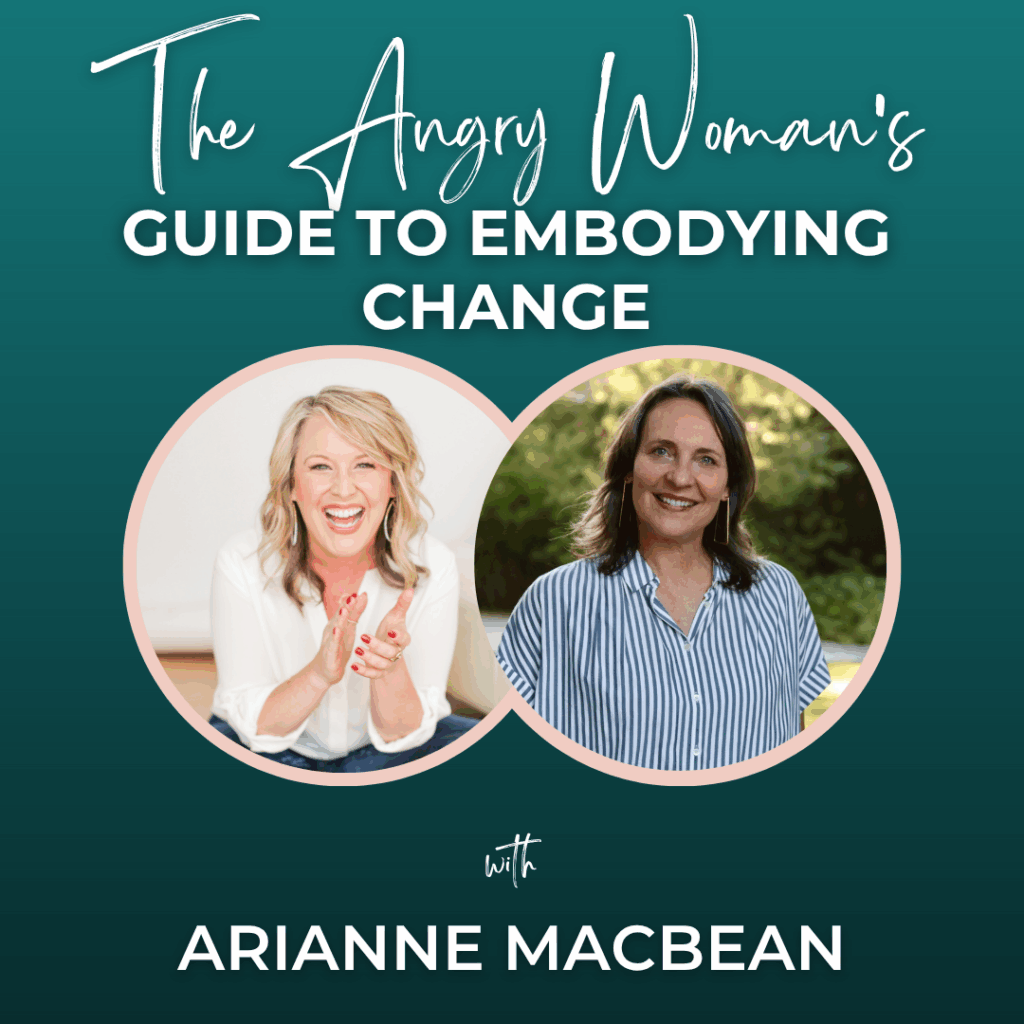
Arianne MacBean writes, “Your anger is the spark of your inner fire.” As outlined in her upcoming book, Tough Shit: The Angry Woman’s Guide to Embodying Change, that spark is something every woman deserves to honor. This week she joins me for a conversation that’s all about reclaiming that fire and learning how to channel it into transformation.
Arianne is a licensed marriage and family therapist in Los Angeles with a certificate in somatic psychotherapies and practices. We talk about the power of anger as a tool for self-knowledge, how the patriarchy taught us to suppress it, and why embracing it is one of the most radical acts of self-compassion a woman can take.
Arianne also shares how her background as a dancer and choreographer shaped her somatic therapy work and how tuning into the body allows us to uncover what’s really beneath our anger: fear, sadness, hurt, and ultimately, truth.
This conversation is such a beautiful reminder that anger isn’t something to fix, it’s something to feel, follow, and transform.
✨ If you’d like to watch the video version of this episode, you can find it here.
What you’ll hear about in this episode:
- Why anger is powerful information, not something to suppress (3:32)
- How somatic therapy connects movement, body awareness, and emotional healing (5:36)
- Ways to use anger as armor and as a guide toward deeper healing (13:20)
- The surprising history behind the phrase “tough shit” and Arianne’s reclamation of it (19:30)
- That there are men actually doing the inner work on themselves, facing hard truths, and learning to show up differently in relationships (34:35)
Learn more about Arianne MacBean: Arianne MacBean is a Somatic Psychotherapist, writer, and educator. She taught dance at the middle, high school, and college levels for over twenty years and was the Artistic Director of The Big Show Co., an LA-based dance-theater group. She holds a BA in Dance from UCLA, a Double MFA in Dance & Writing from California Institute of the Arts, and an MA in Counseling Psychology from Pacifica Graduate Institute. She works with individuals and couples to heal from trauma, learn healthy communication skills, and trust the body’s wealth of wisdom.
Resources & Links:
Focused Strategy Sessions with Kate
The Divorce Survival Guide Resource Bundle
Phoenix Rising: A Divorce Empowerment Collective
Kate on Instagram
Kate on Facebook
Kate’s Substack Newsletter: Divorce Coaching Dispatch
The Divorce Survival Guide Podcast Episodes are also available YouTube!
Pre-Order Arianne’s book, Tough Shit: The Angry Women’s Guide to Embodying Change
Arianne’s website
Arianne on Instagram
Arianne’s Substack
Show transcript:
Arianne MacBean: [00:00:00] When we feel something in our body, we’re told to shut it down and push through. But in this case, I’m asking you when you feel that heat, when you feel that explosion, when you feel that rallying cry, just grab hold of it and brace it, bring it in, and go, let’s follow this. Let’s follow this down to the core, and then we can use it for positive change, not only in our own lives, but.
Arianne MacBean: Maybe even in our world.
Kate Anthony: Welcome to the Divorce Survival Guide Podcast, where we have open and honest conversations about co-parenting, separation, divorce, and the hardest question of all. Should you stay or should you go? I’m Kate Anthony, your divorce survival guide, and I’m here to help you navigate some of the roughest waters you’ve ever swung in and answer some of your toughest questions.
Kate Anthony: I’ve been to hell and back, and now it’s my [00:01:00] mission in life to help you get to the other side of this process with your sanity and your heart intact.
Kate Anthony: Hey everyone. Welcome back. I am excited today to bring you a friend of mine. Some of you may have seen on the Gram my dancing videos from my dance class that I. I used to do in person on Fridays until I moved and my friend Arianne is in that dance class with me. That’s how we have connected and we like to shake it shake it.
Kate Anthony: So she’s a licensed marriage and family therapist in LA and she is, has a certificate in somatic psychotherapies and practices, which you know, I’m all about. And she has a book coming out. You ready for this guys? It is called. Tough shit. The [00:01:00] Angry Woman’s Guide to Embodying Change. And when she told me that she wrote this book and what it was called, I was like yes please.
Kate Anthony: So I’m wearing my trustee, fuck the patriarchy necklace. And her book is coming out on November 4th. But it is available for pre-order everywhere. So we’re gonna get into talking about the book. And all of our anger, all women’s anger, especially right now and all the things. So welcome. I’m so glad to be here.
Kate Anthony: Thank
Arianne MacBean: you. This is so fun. This is so great. I’m so happy to be here.
Kate Anthony: I am so happy that you are here. So all right, let’s start. I wanna start off by talking about your book. Like what precipitated this? Yeah. Tough shit. Yeah. There
Arianne MacBean: it is. I have been working in private practice for the last year and as I started, I came to being a therapist later in life.
Arianne MacBean: I was a dance [00:03:00] educator for 20 years and a choreographer and a dancer, which is why we like to shake it on Fridays. That’s my Friday church. And so around age 47, I went back to grad school to become a therapist and I brought with me my. My years of dance and movement training and teaching to bring, bring that into my therapy practice.
Arianne MacBean: And I noticed in this room that women would come in and pretty much brush off their anger pretty quickly and say that it was bad, that it was bad, that they were angry because. It got them into trouble sometimes with the relationships and I needed to constantly tell people, the anger itself isn’t bad.
Arianne MacBean: It’s information, it’s important information. We would do this work of tracing the [00:03:00] anger ’cause it’s the somatic feeling. When you feel anger, you feel it, it feels hot, it feels that rush. So it’s a great. Somatic tool because it’s so strong in our bodies. So I would work with my clients to track backwards from that more explosive space through fear, which is always underneath anger, sadness, and hurt.
Arianne MacBean: And then we would land. Quite naturally in true self. And what I, and then what we would do with that information is go, okay, so now we know why that’s happening up here, and we can hold that small core pain point within ourselves and have compassion for it because it’s probably connected to all sorts of ancient wounds and.
Arianne MacBean: Move [00:04:00] forward with a kind of embodied consciousness about our reactivity. So I needed to just put it all together. And the other thing that was hard was that, when you meet with clients, it’s once a week. It’s, its one little shot, so I wanted to have something that my clients could work on and work with when they’re not in therapy.
Arianne MacBean: So basically the, it’s a journal to self-reflection and somatic journal. There are writing prompts for each section, starting with fear, starting with anger, fear, sadness, hurt, and true self. And there are somatic popups that go with the writing prompts and so they’re paired so you can have an embodied experience while you are.
Arianne MacBean: Expressing and feeling each emotion.
Kate Anthony: And so the somatic popups, I love everything about this. The somatic popups [00:05:00] are like prompts to. Yeah, do something physical.
Arianne MacBean: So here is a prompt in the sadness section. Devastation is coursing through my body is the prompt, and you can write whatever you need to do about devastation.
Arianne MacBean: And then the somatic popup says, sitting or standing, clap your hands once hard and start rubbing. Keep rubbing as long as you can, generating a little heat. When you notice the temperature rise between your hands, pause and hold. Your palms near your face, fingertips resting on your eyebrows, and the base of your palms just below the cheeks.
Arianne MacBean: Note how you feel, and then it gives you a little description. Friction from rubbing creates warmth, soothing, touching your face, stimulates pressure points, and provides a sense of self comfort. So it gives you a very simple [00:06:00] body movement exercise, if you wanna call it an exercise. It’s very simple to just get into.
Arianne MacBean: The body sense sensations that are happening when you’re feeling and expressing this emotion.
Kate Anthony: I love it. I love it. Yeah. One of the things that I wanna touch on is that, ’cause what I’m hearing in this, and what I also believe, and I’m with you on is that when we talk about women getting in touch with their anger instead of glossing over it.
Kate Anthony: Yeah. And moving past it. Because what, that’s what we tend to do. We’re like, oh God, I feel really angry, but I shouldn’t do that. That’s not okay. And then we. Wanna brush it aside. And we’re not saying that we want women to walk through the world angry all the time. We’re not saying, yeah, there’s a lot to be angry about.
Arianne MacBean: Here’s the thing. Right now what you see is a lot of people, mostly men, but a [00:07:00] lot of people. Using their anger as a kind of truth. Almost like a justification, like the feeling. Now, anger is a secondary emotion. It’s always more of a public face of a smaller emotion. Fear, usually, sadness or hurt.
Arianne MacBean: So now what you’re seeing is that people are using anger as a almost like. A justification for blame, for banishment, for cutting out, abandoning, and no, we and the other side of that spectrum is no, we don’t wanna live in just fury and just embody it ourselves. But there’s actually other things you can do.
Arianne MacBean: You can use the energy of anger, which is what it is, emotions or energies. As a signal of something that something is important to you. And here’s the difference between the outward [00:09:00] projection of that anger. And what I’m asking people to do with this is that we’re using anger to know ourselves.
Arianne MacBean: And I think that is pretty radical right now because we don’t see a lot of people doing that.
Kate Anthony: Yes. I love that there’s so much information in our anger. There’s so much information.
Arianne MacBean: So much information, yeah and that’s why it’s such a great tool because also it is a big feeling. A lot of the times we disconnect when we feel something in our body, we’re told to shut it down and push through.
Arianne MacBean: But in this case. I’m asking you when you feel that heat, when you feel that explosion, when you feel that rallying cry to just grab, just grab hold of it and brace it, bring it in, and go, let’s follow this. Let’s follow this down to the core, and then we can use it for positive change, not [00:10:00] only in our own lives, but.
Arianne MacBean: Maybe even in our world,
Kate Anthony: Really the information that we’re talking about is, as you said, like you’re distilling it down down to true self.
Arianne MacBean: Yeah. It’s really about self-reflection here and making changes within your own and reframing your own understanding of who you are. And if you do that, you automatically move through the world differently.
Arianne MacBean: Yeah. One of the things we talk about. We talked about always in, in dance was if you move, if you look at, if you, sorry, if you pay attention to your shoulder changes. And I feel this is because it’s true. If you’re just moving through your dance class and you’re doing this with your arms, you’re doing it.
Arianne MacBean: But if you focus on the shoulder and you do this. It changes the movement and changes everything. So I believe it’s the same thing with psyche and emotions. If we pay attention. [00:11:00] We change.
Arianne MacBean: It’s that simple.
Kate Anthony: It’s that simple and that profound, and this is a radical act for women in particular because we have been taught that our anger is not okay, that our anger is wrong.
Kate Anthony: That, it’s not a female emotion. Men are allowed to be as angry as they want. And it’s a hard. Emotion, which doesn’t belong. And if we are angry, we’re a bitch. And so to stop women in their tracks and say no, let’s experience this.
Arianne MacBean: It’s really much more than just feeling and expressing it’s about getting into the nuance of it and to really be vulnerable actually it, because in the anger.
Arianne MacBean: It’s a sort of smoke signal, right? For something that’s going on very deep inside of us. And usually it has something to do with the way that we’ve been treated or messages [00:12:00] we’ve gotten that we don’t even know we might be carrying on unknowing that we’re carrying them.
Kate Anthony: I’m just reminded of a conversation I had with a client yesterday about her anger and that, and we were talking about the idea of, she says she’s wearing her anger right now, like a shield. It’s like a cloak of armor. She’s a lot to be angry about in her. In her marriage, we were talking about the. effectiveness of working through that anger while she’s still in a situation that’s unsafe.
Kate Anthony: My reaction to that was not yet right. You’re holding it. It is a cloak and it is your armor and it is your protection and for a reason. I think there, there does need to be a safe container of therapy, right? Or, working through these things when you’re first confronting that.
Kate Anthony: What might be under the anger, right?
Arianne MacBean: Yeah.
Kate Anthony: We have to protect [00:14:00] that true self, those softer feelings. We do the pain, we do. How do you, how would you recommend people knowing that my audience is going through these very delicate, very difficult times, right? And they have a lot of anger, some of it, most of it.
Kate Anthony: Very righteous, but also. Protective.
Arianne MacBean: I would say the journal. This journal or any journal is a really wonderful place to, hopefully it’s private. Keep it private, lock it away in your car, wherever you need it to process and track your feelings. But I love this image that you talked about of the wearing, of the anger, and that reminds me of.
Arianne MacBean: An embodied practice too, around walking through your day with a consciousness of that anger armor. How does that, if you walk into Trader Joe’s with that anger [00:15:00] armor on, how does that change how you feel and how does it change how you interact? Because you’re protecting the softer underbelly underneath that.
Arianne MacBean: And then maybe if there’s a moment in your bathroom in the evening where you can literally visualize taking the parts of the arm armor off and revealing the naked truth, stepping into the bath, being in a place where you can really just be scared, be sad, locking that door. Be afraid. There is a lot that we can do with these kinds of somatic visualizations that are incredibly powerful.
Arianne MacBean: Even something like this, like a gesture that if that your client created a gesture like this, and when she needed to, when she was feeling vulnerable to, to discreetly create a gesture to [00:16:00] remind her of her armor.
Kate Anthony: For those of you who are listening and not watching, what Arianne is doing right now is crossing her arms in front of her like a, like you would in a protective,
Arianne MacBean: like a shield
Kate Anthony: or like a protective shield.
Kate Anthony: And then to if, when you feel unsafe, to actually intentionally create, cross your arms in front of your chest to create that shield. So you’re calling, you’re, there’s an intentionality to it. Yes.
Arianne MacBean: Using your body, using your gestural your pose, your posture to call up parts of yourself. In fact, one of the, at each section, at the end of each section in the journal, it asks you to do something with the page, the the, at the very end of the anger section.
Arianne MacBean: The book asks you to tear the page out, rumple it as hard as you can, and throw it in the corner of your room. The fear page [00:17:00] asks you to rip it out and hold it in front of you like a shield, just like your client, and to feel what it feels like to just have to feel, hold a position that feels protective, that’s something you can draw on.
Arianne MacBean: I know it sounds like a little woo, but it really, when you embody an emotion and embody. The understanding of what you’re going through, like physically somatically, it’s a whole new way of knowing and understanding. Absolutely.
Kate Anthony: I think at this point the science on somatics is so clear and it may sound woo, we’ve been talking about going women going to the bathroom and doing power poses in in a bathroom stall before a meeting for years now, right?
Kate Anthony: Yeah. For, over a decade. So this is becoming far more. I think commonplace, and we talk about somatics a lot on my show because it is really important. It, and in with my clients, right? This embodiment we are [00:18:00] so we get so stuck in our heads, should I stay or should I go, should I, is it this bad?
Kate Anthony: Is it that bad? We’re taking constant measurements and comparisons and dah. And when I ask my clients, right? Or when I ask my audience to just stop, breathe, and feel.
Arianne MacBean: Listen to your body. What is it saying right now?
Kate Anthony: Yeah. Yeah. And it’s boom.
Arianne MacBean: Yep.
Kate Anthony: Now we don’t have to do anything about it.
Kate Anthony: ’cause it could be scary information and maybe it’s too much and whatever. We don’t have to like, we don’t have to follow the path, but let’s at least see what it is.
Arianne MacBean: Let’s get with the, yeah. Let’s get with the truth as it feels right now. And Yeah, I absolutely agree with you. It can be. Those of us who have had those moments, those bam moments that you talk about, there’s no denying it.
Arianne MacBean: And you’re right, it can be confusing and scary. We are not really taught to value the [00:19:00] wisdom of the body. So there is unpacking to do after the felt experience for sure. Yeah. And that has to be
Kate Anthony: held tenderly. That’s right. And it should be done in therapy with a good. Trained coach something in some c apacity that is in a safe space with somebody who’s actually trained to deal with it, yes. With the rest of it. Yes. Absolutely. Wait I have a question. Yeah. How did you come up with your title? Tough shit.
Arianne MacBean: Ah. I knew I had to call it tough shit because I actually have a personal and historical relationship with the phrase myself.
Arianne MacBean: And actually I went on a deep dive into this particular idiom, it was actually first used in the 18 hundreds. In a newspaper where the first time this phrase was mentioned was by a man who the quote was something like the original [00:21:00] version of this phrase was Tough titties. Tough titties.
Arianne MacBean: Sure. Yep. And it, yep. And it was, and the quote was, tough titties. Tough titties. Boys we’ll suck it up. And it was basically. Calling to the men to using the metaphor of the dry breast uhhuh, that when you can’t get what you want, you just gotta suck it up. You mean? You gotta suck it till it’s dry and then just deal with it uhhuh.
Arianne MacBean: So then the phrase shifted. To tough luck in the depression, which was another way that the patriarchy used this idea of repressing emotions to steer people away from blaming the structures that were failing them.
Kate Anthony: Oh,
Arianne MacBean: okay,
Kate Anthony: so it’s, you’ve just got tough luck. Not that the entire system is set [00:22:00] up to have you fail.
Kate Anthony: Interesting.
Arianne MacBean: Exactly. Then in World War I, we went to, got the tough shit phrase and of course in military language, tough shit is basically, there’s nothing else but the order. Do it and if you don’t like it, tough shit. In the military world, that was really about lose your independent thinking.
Arianne MacBean: Follow orders. That’s it. That’s all you need to do.
Kate Anthony: You’re just a cog in this wheel. You don’t get to have feelings about it. You don’t get to, it’s just right.
Arianne MacBean: Then in the seventies when I was growing up, it became tough noogies. Now noogies is a playground game where you knuckles put your knuckles in somebody’s head.
Arianne MacBean: So in this case. They infantalized the phrase by saying, tough noogies. It’s just a game. Don’t work. Don’t make it such a big deal. Don’t you [00:23:00] know if it hurts? Knuckles on your head hurts tough noogies. Again, another kind of way to just say, it’s all a game. It doesn’t matter. Brush off your feelings.
Arianne MacBean: So here we are. I’m taking back tough shit and I’m using it to, as a reclamation to say tough shit. I actually do have feelings. I actually am angry. I actually am scared. I’m sad and I’m hurt and I’m going to deal with it and because I’m gonna deal with it, you’re gonna deal with it. So yeah, there are actually.
Arianne MacBean: Over 20 idioms in the American language that basically mean the, essentially the same thing. Tough shit. Don’t cry over spilled milk. Tough luck buttercup, or something like that. Yeah. Uhhuh, suck it up buttercup. Suck it up buttercup. Yep. And then of course, the ultimate of the patriarchy.
Arianne MacBean: Pull yourselves up by your bootstraps. [00:24:00] Don’t complain. Just keep trucking. Don’t be a pussy. Yep. Grow a pair. We have more than any other language. We have phrases that basically, essentially mean this. Wow. That is fascinating. It’s pretty, it’s really crazy to think that our country was developed with this notion of dismissing real essential, valid feelings.
Arianne MacBean: Both in both men and women. The patriarchy fucked men too. Fuck,
Kate Anthony: absolutely.
Arianne MacBean: I
Kate Anthony: say it all the time. Screen for the rooftops. This isn’t working for you guys either. That’s why you’re committing suicide at higher rates than ever before. This is not a, this is not working for you either. Absolutely. So fascinating.
Kate Anthony: I didn’t know any of that. I was like, I love the title Tough Shit, but now I love it even more.
Arianne MacBean: Tough noogies was used, like my dad used that. That was like a [00:26:00] classic in my, in when I was growing up. If I didn’t. What was happening to me or what was being offered to me, it was tough. No, that’s right.
Arianne MacBean: And that was the message that I needed to not want what I not want something different. Not think differently, not feel the same, that the way that I don’t know, just to not be who I was, basically. So again, personal and historical reclaiming of this phrase.
Kate Anthony: Divorce is hard. No question about it. The uncertainty, the isolation. It can feel like you’re drowning, but you don’t have to go through this alone. There’s a place where you can gather with other women going through divorce. And get expert advice from professionals like me. Phoenix Rising a Divorce Empowerment Collective.
Kate Anthony: [00:24:00] Phoenix Rising is an ongoing group coaching program designed to walk you through some of the hardest parts of your divorce in community with other women who are going through it too. In Phoenix Rising, you get three live coaching sessions with me every month, plus a guest expert call with a top industry professional.
Kate Anthony: Every month you’ll learn exactly what to do, when and how, but more importantly, you’ll have a community of women who truly understand because when women come together and share their stories, something powerful happens. We rise. We gain strength, we reclaim our voices, and we move forward, not just surviving.
Kate Anthony: Thriving inside Phoenix Rising. You’ll get expert guidance, a safe and supportive space, and the kind of sisterhood that changes everything. Enrollment is always open, so join us at kate anthony.com/decided today. That’s kate anthony.com/decided and we will welcome you [00:25:00] with open arms.
Kate Anthony: In your own personal history are there ways in which you have expressed or not expressed anger that. You have learned from this ex from, your studies and your, and now your practice. Do you reflect back and go, oh, that’s interesting. In that period of my life, I was really not, not that most of us in our twenties are pretty shitty about most of that, but Yeah.
Kate Anthony: Are there, do you have sort of personal reflections on that for yourself?
Arianne MacBean: Oh yeah. I think. I could talk for a long time in the lot, the different threads where anger has shown up. I recently. For, as part of my book launch, I’ve been hosting some workshops. One of the workshops is by Monette Chilson.
Arianne MacBean: She’s a pilgrim and an excavator of the [00:27:00] feminine. She led a ritual where she did some shamanic rattling and asked us to, after talking for a bit around about excavating truth out of stories that were told to us about ourselves. She asked us to go into a meditation to think about the stories that were told about us and to maybe seek out and excavate some alternate versions of that story.
Arianne MacBean: And one of the things right when she was telling me about this, that this is what she wanted to do for the ritual, I had this sudden revelation. My parents divorced when I was one. I was pre-verbal. Me too. Okay. And everything according to Lore, family lore was that it was fine that I did fine, that I never had any issue with going between my mom and my dad’s house, even though my dad lived in [00:28:00] Australia and I was sent on a plane by myself when I was three.
Arianne MacBean: God what to go live with him. Oh God. But I was fine, but I was fine. I was fine.
Kate Anthony: Oh, Uhhuh as a parent, right? As a parent, we’re like, what? Fucking seventies, man.
Arianne MacBean: Yeah. Seventies. Yep. I bought into that story for so long. I bought in. I guess I was fine, but I had this revelation right before I talked to Monette that I had no memory whatsoever.
Arianne MacBean: Of any of the times that I was transported from one parent to the other, I have memories of being with my dad and being with my mom, but I don’t have memories of being dropped off, picked up, being on a plane, all of that. So I took that into the ritual as she was doing this beautiful shamanic rattling, which is like four beats per second, like a, and it’s hypnotizing and really beautiful.
Arianne MacBean: I, I [00:28:00] went into trying to work with this empty space this no memory zone that I have with being transported from one parent to the other, and I visualized baby me getting past. From my father to my mother and then my mother back to my father in the rhythm of the rattling. And I noticed as I continued to look, visualize and meditate on this dance that was happening that the baby me never really, as I was getting passed from one, I was looking at the other, as I was passed to the other, I was looking at, I never got, either one of ’em held me and saw me.
Arianne MacBean: Do you know what I’m saying? And then I started to think, wow, this is ironically what I wrote about in my thesis for grad school was this idea of liminal imminence in movement, which means basically your connection with the divine self when you move, [00:31:00] when you dance, when you’re in between positionality.
Arianne MacBean: And it all hit me like, oh, so I turned baby me. Experiencing this turned this movement, this dynamic movement. Yeah. And I became a dancer. Yeah. And I became
Kate Anthony: a choreographer and I to make sense of that space in between yes.
Arianne MacBean: To make sense of it. Maybe even to exalt in it to own it, to make it.
Arianne MacBean: Make it divine. But on the other side of that, as she kept rattling, I felt the raining down of rage that I never got to be locked into one place, one body, one caregiver who would not, lemme go [00:32:00] and honestly. I think that’s the root of a lot of my anger that gets, threaded out in other ways.
Arianne MacBean: Yeah. Uhhuh,
Kate Anthony: I relate to it in so many ways, right? The, I was not passed back and forth very much ’cause my dad was not there as much. I was, when I was little, the feeling of never actually having a, I, there was no attachment I, there was no attachment to either one of them. Really?
Arianne MacBean: Yeah.
Kate Anthony: For all of the reasons.
Kate Anthony: Never having, yeah. That and interestingly never having that sense of self that is derived of a healthy, secure attachment connection. Yes. Being with, so I became a dancer and an actor. Yeah. Yeah. I to be all these other people. Yes. I don’t have to be. Yes. I don’t know who I am, so I’ll just be all these other [00:33:00] people.
Arianne MacBean: Yes.
Kate Anthony: And codependent and a chameleon, and I’ll be whatever you want me to be.
Arianne MacBean: Yeah. And I think the shadow side that, these are coping mechanisms that we did pretty well with. That’s right. To a certain extent. We, we got a lot of what we needed. In that realm.
Arianne MacBean: The shadow side of that is the dark. The consequence of that, which is that we’re doing it because we don’t know in an embodied way what it feels like to be home in our own selves and held by a secure other. And so often speaking of marriages, so often we try to heal that original attachment wound with our partner who has their own attachment issues and most likely isn’t gonna be a secure parent figure for us because that’s not their job anyway.
Kate Anthony: It’s not [00:35:00] their job. Yeah. Sorry. Harville Hendricks. But that’s actually not their job. Having spent entirely too much time in Imago therapy with my ex-husband, I can tell you it doesn’t work. It works for a lot of things. I think it teaches great communication skills, maybe that’s about it.
Kate Anthony: They are not the one, they are not our healer. They might be our teacher.
Arianne MacBean: Yeah. The relationship, if we do the work. The things that come up in the relationship can point us, of course, back to our anger, fears, sadness, and hurt and to true self, and we’re the ones that have to do the reframing and the digging.
Kate Anthony: Do you find in your practice that this is gonna be a. A hot button question, but everyone in my audience is used to it, that men are as willing to do that level of digging.
Arianne MacBean: My clients do [00:36:00]. My male clients do. Yeah. Yeah, they do. I love it. They really do. It’s given me a lot of hope to be honest. Yeah.
Arianne MacBean: I have men across the ages. I have young men. I have middle-aged men. I have a couple of 75, 80 5-year-old men, and they’re all doing the really hard work of self, and some of them are really doing it because they wanna be better in the relationship.
Kate Anthony: For my audience, listening or watching right now, I do want you guys to hear this, that there are men doing the work and that this is what it takes.
Kate Anthony: Like it takes the courage and the consistency. And it’s hard. And it’s hard and it’s scary, but like we are doing it. You are doing it.
Arianne MacBean: Oh yeah. And they’re facing really tough shit about themselves. They really are. And how their fears and how their [00:37:00] biases, and how their old messaging has taken them astray.
Arianne MacBean: Yeah, I know because word on the street. Is that it’s really tough out there in the dating game because quite frankly, women are so more profoundly in general in touch with they’re shit and willing, at least willing to process it and have open conversations about it without getting activated. But I can say in my little world, in my at Synergy Somatic Psychotherapy, the men coming in here are doing good work.
Kate Anthony: That’s really great. It’s good to hear because No, it is, it’s important because I know I can, I have certainly been guilty of, just throwing up my hands and like doing the work and I dunno what to tell you until something changes, but I do think there is a, there’s a shifting tide, generally speaking.
Kate Anthony: There’s a shifting patriarchal tide, right? Where we [00:39:00] women, women no longer quote, need men for their money. For, for access. To have babies. To have babies, right? There’s a lot of shit that we don’t need them for anymore. No. And the response. From men, I think is lagging, right? Yeah.
Kate Anthony: And a lot of them just get angry and use that anger like their wounds a little bit. Yeah. And use that anger and bravado to be more oppressive, right? To try and maintain and hold back and take back that power. Yeah. But there’s a small as what you’re saying and what I’m hearing and I hear around is there are small pockets where men are like, okay.
Kate Anthony: This whole system that we created to support us doesn’t actually work to maintain our power. And women are done with it. And so if we wanna be in relationship with women, we actually have to, we had to change too.
Arianne MacBean: Yeah. The thing about any [00:40:00] kind of therapeutic work, whether it’s couples work or individual work, we talk about the other to understand ourselves.
Arianne MacBean: So often people come into therapy and they just wanna talk shit about whatever, all the people in their lives that they are bugging, that are bugging them. And our jobs as therapists is to make that feel acceptable and welcome. And, yes safe, but also to then use that information to redirect. And what do you think, why do you think that you feel that way?
Arianne MacBean: What does that remind you of? Where did you, when did you start feeling that way? Have you always felt that way about that kind of behavior? So yeah. Healing is self work. Yeah. For men and for women. That’s right.
Kate Anthony: I’m happy to hear that that men are engaging in it. ’cause I think also the somatic work is the scariest.
Kate Anthony: It’s the, it’s the, it’s the, that, that’s it. We’re going [00:41:00] in, so I’m really glad I am so happy that this book is coming out. I am so happy that you have shared it with me and my audience and your work and everything. The book now. Tough shit is on pre-order. It’s available on pre-order now and yes, to be clear, it is not just called tough shit.
Kate Anthony: It is called Tough Shit. The Angry Woman’s Guide to Embodying Change.
Arianne MacBean: It’s a really wonderful publishing company too. Just giving a shout out to TE Home Center Publishing. They celebrate feminist, queer and bipoc authors and they are a team of fabulous women, so who are really trying to get. Support voices that are marginalized and I’m really proud to be a part of that organization.
Arianne MacBean: And yeah, we’re gonna have an amazing little tough shit tonic and a tough shit tea. And we have already created a [00:38:00] tough shit Spotify list with some ra, some raging feminist music. Oh my God,
Kate Anthony: that’s amazing. I love this.
Arianne MacBean: So I’ll share that with you. It’s all do be found on my Instagram at Synergy Somatics.
Arianne MacBean: Okay. So everything,
Kate Anthony: All every links to everything will be on your Instagram Synergy somatics. Yeah. And we’ll get them in the show notes too. Great. And guys. Pre-orders matter for authors, so they do. If you are interested, and this sounds like something that you would love, by the way, you all are, this is your homework.
Kate Anthony: This is not negotiable. I want all of you to get this book
Arianne MacBean: By the way, the thing that my publishers told me is that if this book gets 50 sales and 55 star reviews in the first week. A publication, it automatically subverts the patriarchal algorithm of Amazon and unlocks free advertising that you can usually only [00:43:00] get if you are a big time publishing company with a big name and a big influencer.
Arianne MacBean: So all we need is 50.
Kate Anthony: Guys. All right, everybody, get on your computer right now. Go to Barnes and Noble. For some reason right now, as of today when we’re recording, Amazon only has a pre-order for Kindle, which doesn’t make sense because I think that’s gonna change. Yeah. So hopefully that’ll change. But we did find it on Barnes and Noble and other places and do you have a website for this?
Arianne MacBean: Yeah. Yeah. My, my synergy somatic psychotherapy is where everything is housed.
Kate Anthony: Yeah. Okay. So that’s where we’re gonna go. You’re gonna pre-order this book. You guys are gonna start doing this work. You’re gonna thank me and for anyone who is local to Pasadena ish area, that is where Arianne practices would love to see you.
Arianne MacBean: Yeah. Yeah. We’ll have a fun book launch event on the ninth too. The information about that. Thank you so much, Kate. This is just such an amazing thing that you’re doing for women [00:44:00] who are going through transition. Big life transition. We need each other in these moments where it’s so important to feel not alone.
Arianne MacBean: Man, let’s just keep building the community of angry women using that. Using that anger for positive change.
Kate Anthony: You see my, behind me, I’ve got my. Fuck you woman. Yes.
Kate Anthony: You know that’s right. Arianne. I love it. I love you. I’m so happy that we got to have this conversation. Thank you so much for being here.
Arianne MacBean: Thank you so much. Wonderful to be here.
Kate Anthony: Thanks for tuning in to another episode of the Divorce Survival Guide podcast. If you like what you hear, head on over to Apple Podcasts or wherever you listen in and leave me a review. And don’t forget to follow me on Instagram at Kate Anthony underscore divorce coach. I’ll see you next time and until then, remember that you, my love, deserve to be happy.
===================
DISCLAIMER: THE COMMENTARY AND OPINIONS AVAILABLE ON THIS PODCAST ARE FOR INFORMATIONAL AND ENTERTAINMENT PURPOSES ONLY AND NOT FOR THE PURPOSE OF PROVIDING LEGAL OR PSYCHOLOGICAL ADVICE. YOU SHOULD CONTACT AN ATTORNEY, COACH, OR THERAPIST IN YOUR STATE TO OBTAIN ADVICE WITH RESPECT TO ANY PARTICULAR ISSUE OR PROBLEM.
===================